Embedding-based retrieval has a geometry problem that most teams building AI systems have not accounted for.
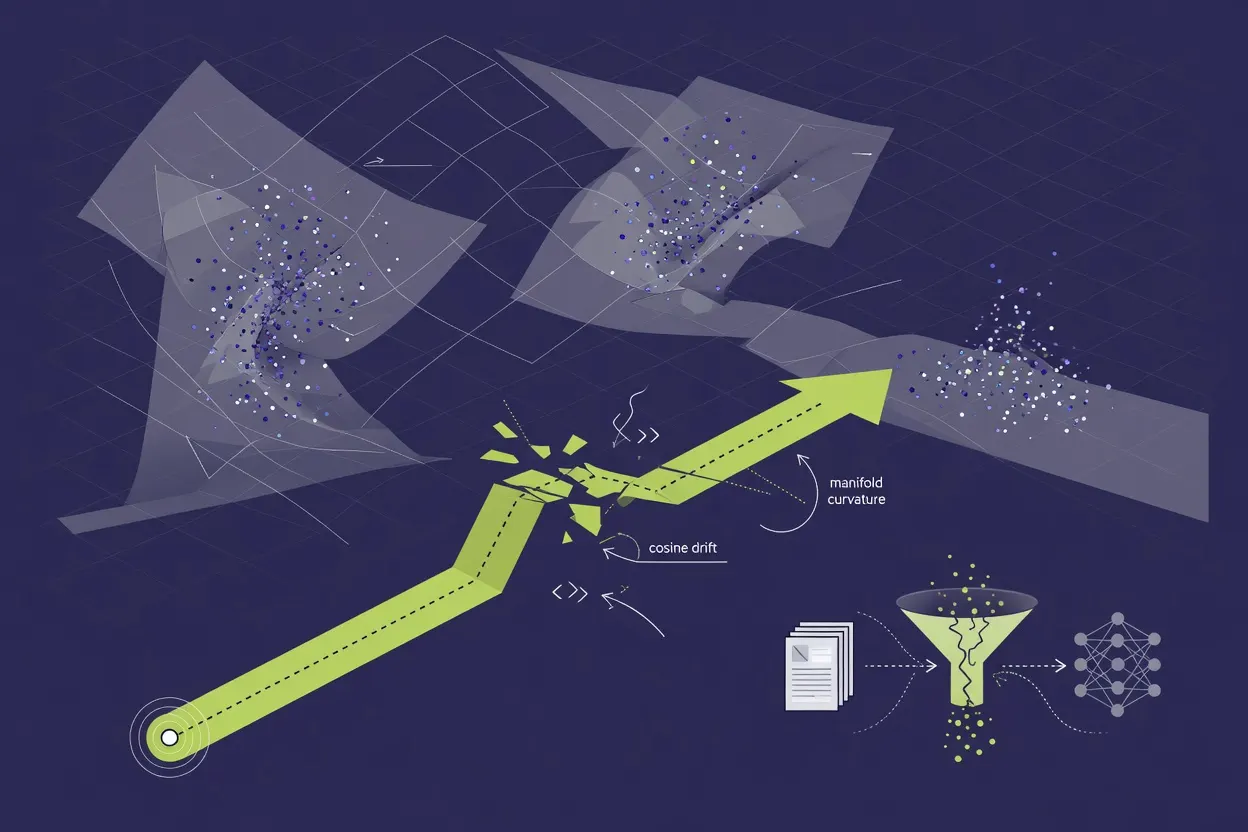
A paper posted to arXiv examines what happens to similarity search as vector dimensions increase. The short answer: it gets unreliable in ways that are hard to spot. The researchers ran controlled experiments across synthetic distributions and found that as dimensionality rises, cosine similarity scores bunch together — a phenomenon called contrast collapse — making it increasingly difficult for a retrieval system to distinguish a highly relevant document from a merely adjacent one. Compounding the problem is hubness, a structural bias where a small number of vectors end up as the nearest neighbor for a disproportionate share of queries, skewing what gets retrieved regardless of actual relevance. The paper also tested a simplified retrieval-augmented generation setup and found these geometric distortions propagate upstream, weakening the factual grounding that RAG is supposed to provide.
This matters because RAG has become the default architecture for giving large language models access to external knowledge — internal wikis, customer data, legal documents. If the retrieval layer is geometrically compromised, the model confidently answers from the wrong context, and the failure is invisible without deliberate auditing. The researchers are calling for geometry-aware diagnostics and robustness-focused retrieval strategies, neither of which are standard practice today.
The experiments use synthetic data by design, to isolate the geometric effects from dataset-specific noise — which means real-world retrieval, with its messy corpora and varied embedding models, may behave even less predictably than these controlled results suggest.