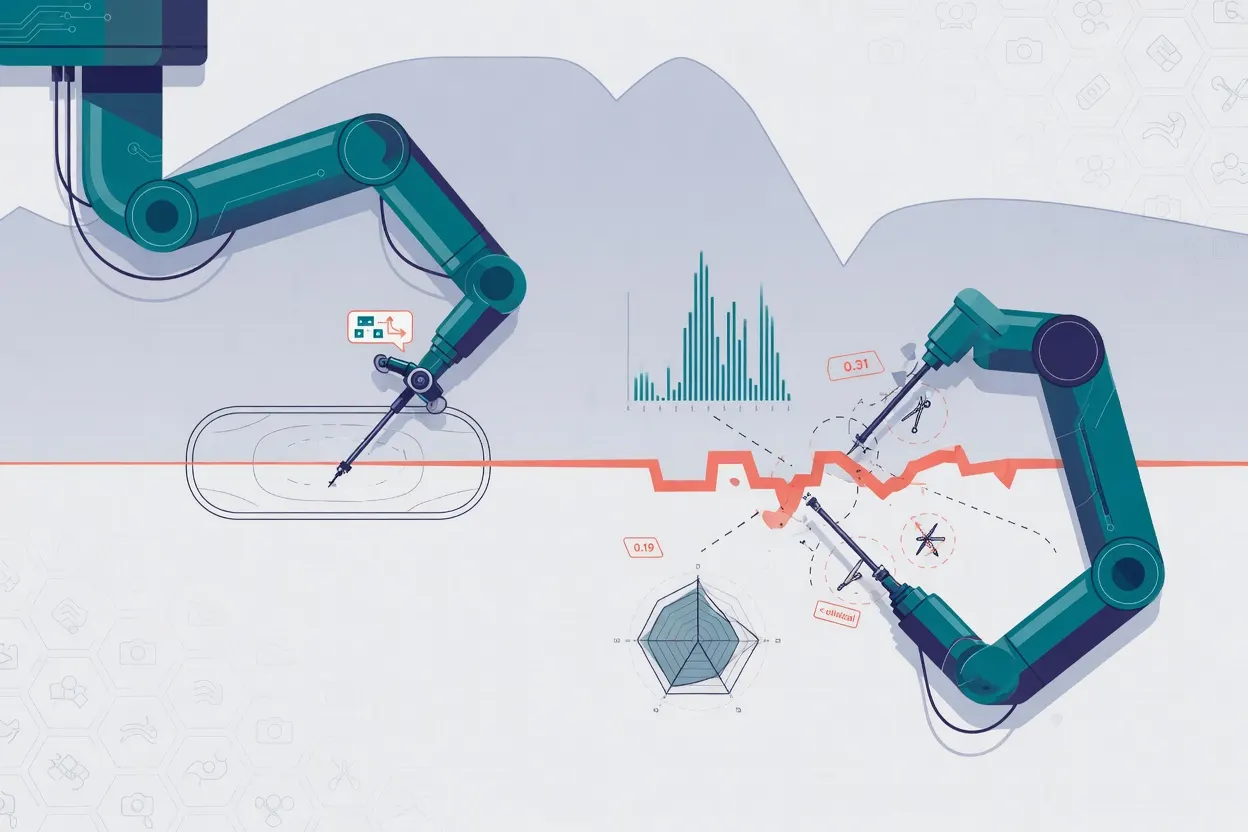
Researchers have released SurgVLA-Bench, the first standardized benchmark for testing AI models that control laparoscopic surgical robots.
The benchmark, built on the SurRoL simulation platform, organizes tasks into a hierarchy from simple atomic motions up to complete surgical procedures. The team tested two families of models: autoregressive systems like OpenVLA and flow-matching systems including pi-zero, pi-zero-point-five, and SmolVLA. Results split along predictable lines — autoregressive models handled semantic understanding better, while flow-matching models landed more precise physical actions but showed weaker generalization. None of them performed well enough to matter clinically.
The gap matters because surgical robotics has lacked any shared yardstick. General robotics has plenty of benchmarks, but laparoscopic surgery introduces constraints — a narrow endoscopic field of view, restricted camera angles, and constant occlusion from tissue and instruments — that generic evaluations ignore entirely. Without a surgical-specific benchmark, labs building these models had no honest way to compare progress or identify failure modes.
The fundamental bottlenecks the paper identifies are physical, not algorithmic: you cannot train your way past a camera that can only see a small fraction of the operative field. That is the kind of detail that tends to get buried when research headlines lead with capability rather than constraint.