Reinforcement learning that makes a smarter model reason more clearly for dumber ones — without losing any of its edge — is the core claim of a new paper out of the RLVR research community.
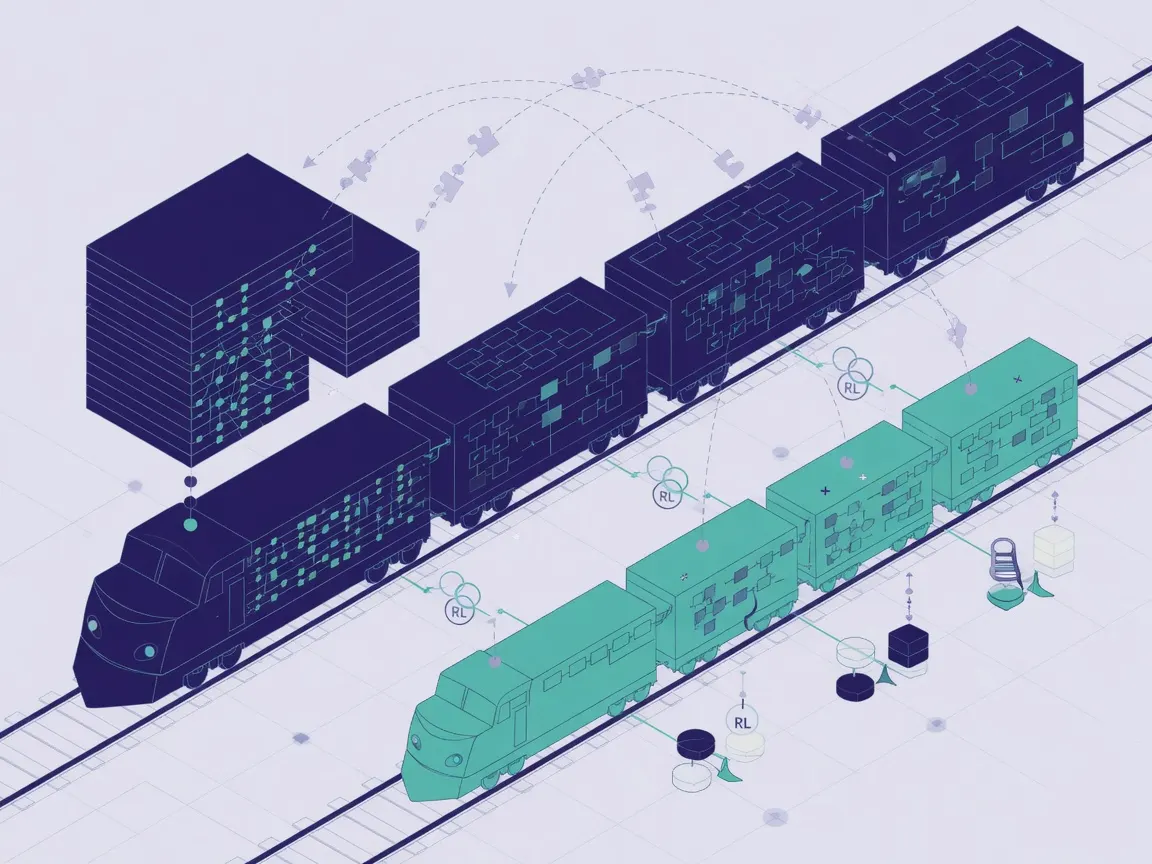
The technique, called Tandem Reinforcement Learning (TRL), pairs a stronger "senior" model with a frozen, weaker "junior" during training. The two alternate stochastically to co-generate reasoning chains, and both are rewarded as a team. The practical effect: the senior learns to think in ways the junior can actually follow. Tested on Qwen3-4B-Instruct doing competition math, TRL matched standard GRPO training on solo reasoning performance while producing chains of thought that were more legible, less prone to language mixing, and more robust when the junior model had to pick up mid-reasoning.
This matters because RLVR has a known drift problem. Models trained to maximize reward on verifiable tasks tend to develop idiosyncratic reasoning patterns — poor readability, language switching, opaque shorthand — that score well on benchmarks but are nearly useless to anyone trying to audit or build on top of them. TRL attacks that problem at the training level rather than patching it with post-hoc filtering or prompting hacks.
The catch: this is still a single-domain proof scaled slightly beyond prior proof-of-concept work, not a production deployment. Competition math is a narrow, well-structured domain, and whether the legibility gains survive into messier real-world tasks remains unshown.