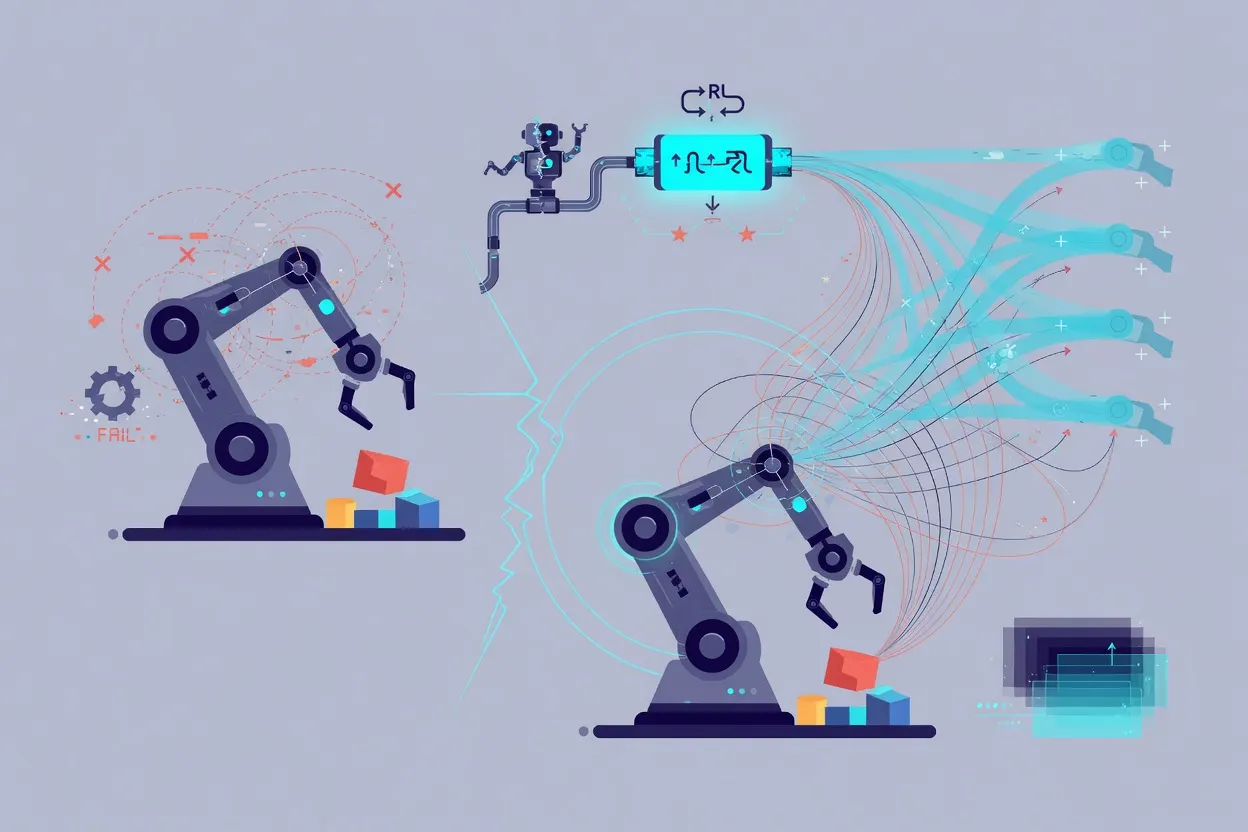
A new training trick gets robot AI to stop drawing a blank on tasks it previously failed 100% of the time.
Researchers built SynthDemo-RL, a pipeline that trains a 'teacher' program to generate successful robot-arm trajectories using privileged information only available in simulation, then uses those synthetic examples to teach a vision-language-action model - the kind of AI that maps camera images and instructions directly to robot movements. A reinforcement learning step called PPO, which rewards the model only when it completes a task, then sharpens the result. On LIBERO-PRO, a benchmark of intentionally perturbed manipulation tasks with no existing demonstrations, a baseline model scored exactly 0% success on 27 of 57 tasks. Running reinforcement learning alone on that same baseline rescued just 10 of those tasks; adding SynthDemo-RL's synthetic demonstrations rescued all 27, pushing average success above 97% on both scoring axes the benchmark tracks.
The real bottleneck in robot training has always been collecting enough human teleoperation demos, and sparse-reward reinforcement learning alone usually can't bootstrap a policy that has never once succeeded. SynthDemo-RL sidesteps that by manufacturing its own training data instead of waiting on a person with a joystick - and it does it well enough to land within 1.7 points of a model trained on 50 real human demonstrations per task.
The team also reports that trajectories generated in a simulated robot twin ran successfully on a physical robot without further tuning. Promising, though it's one lab's benchmark, and 'works in simulation' has burned robotics researchers before.