Feeding robots more human video doesn't automatically make them smarter. How well that video lines up with robot actions does.
A new study called AtomEgo tested three ways of mixing egocentric human interaction footage into the training of embodied foundation models, the systems that let robots see, understand language, and act. Researchers built a corpus of roughly 2,659 hours of this footage and ran it through a pipeline covering vision-language-action and world-action model architectures. They compared joint co-training with robot-specific action heads, gradual transfer from human to robot embodiment, and joint video-action modeling, then tested the results on real robots across multiple tasks.
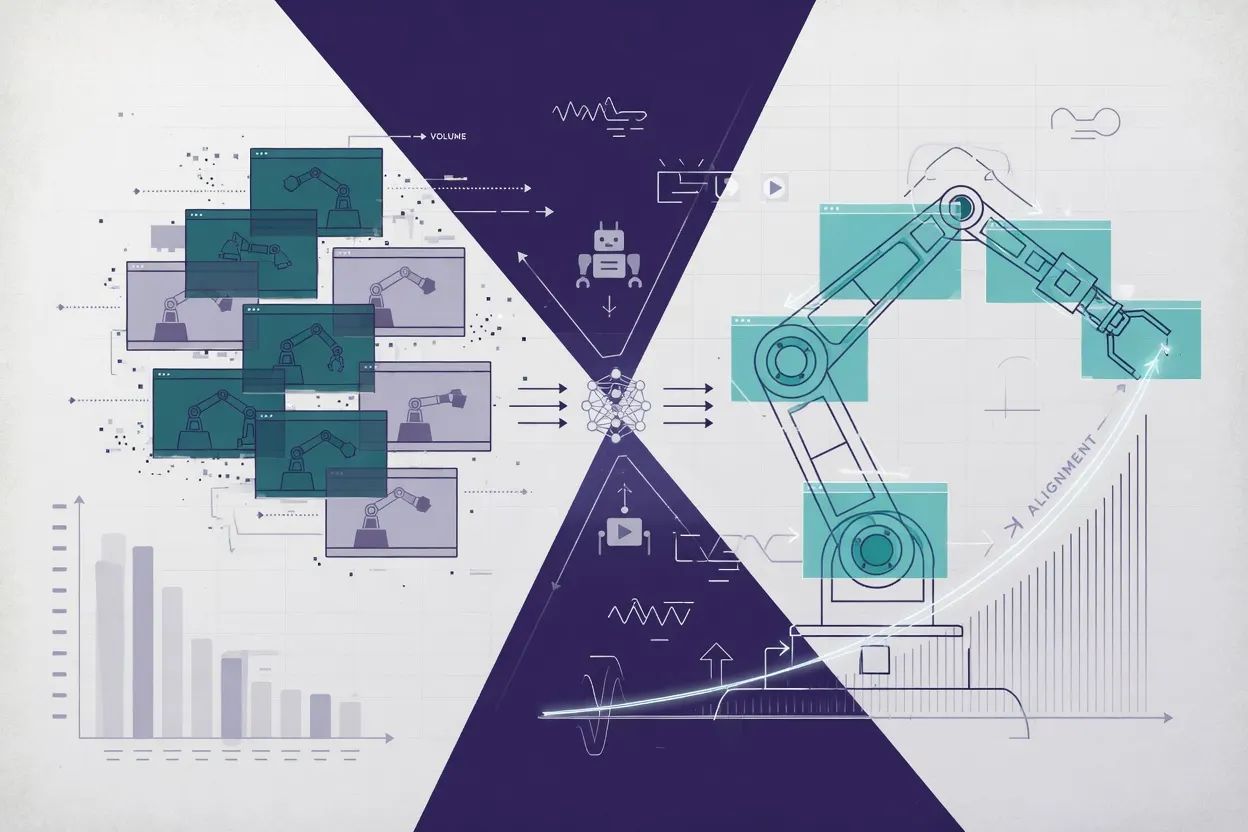
The headline finding: capability gains track data scale multiplied by alignment quality, not data scale alone. Human video can help a robot generalize to new situations, but only if the pipeline actually reconciles the mismatch between a human body and a robot's action space. Dump in unaligned footage and the extra hours buy little.
This cuts against the industry's default instinct to treat embodied AI as a scaling problem solvable by hoovering up more human video, the way YouTube-scale datasets fueled language models. AtomEgo suggests the harder, less glamorous work is the alignment step, not the collection step. That's a less fundable pitch than "we scraped a million hours of hands," but it's the one the data supports.