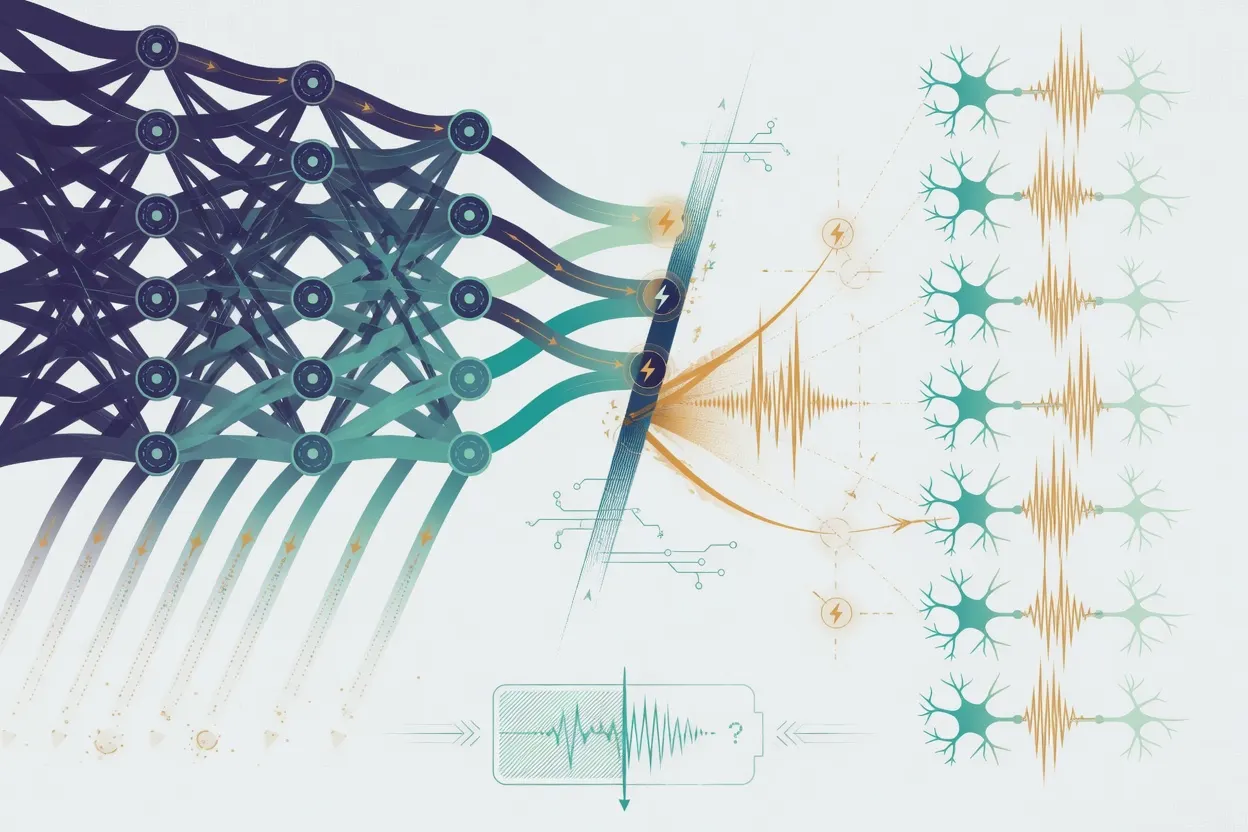
Researchers have combined two very different neural network designs to make graph-based AI lighter on power - at least in theory.
Continuous graph neural networks (CGNNs) generalize standard GNNs by treating information propagation as a continuous process, modeled with differential equations instead of discrete layers, but that flexibility costs serious compute - a problem for battery-powered devices. A new paper proposes COS-GNN, which swaps in spiking neural networks (SNNs), a brain-inspired design that only fires when needed, to represent graph nodes at each time step before feeding those spikes into the continuous process. To stop information leaking out during the spiking steps, the authors add a second-order version of the model and provide a proof that it avoids the exploding and vanishing gradient problems common in deep sequence models. Tests on graph-learning benchmarks show COS-GNN outperforming competitive baselines.
SNNs are prized for energy efficiency because their neurons stay silent except when they spike, unlike conventional networks that compute on every pass regardless of need. That is the entire rationale for pairing them with CGNNs: continuous-time graph learning without the usual power bill. But that is an assumption imported from what SNNs are generally known to do - the paper itself never measures power or energy, only accuracy against baselines.
Until someone benchmarks COS-GNN on real hardware with a power meter, call the efficiency angle a hypothesis, not a finding.