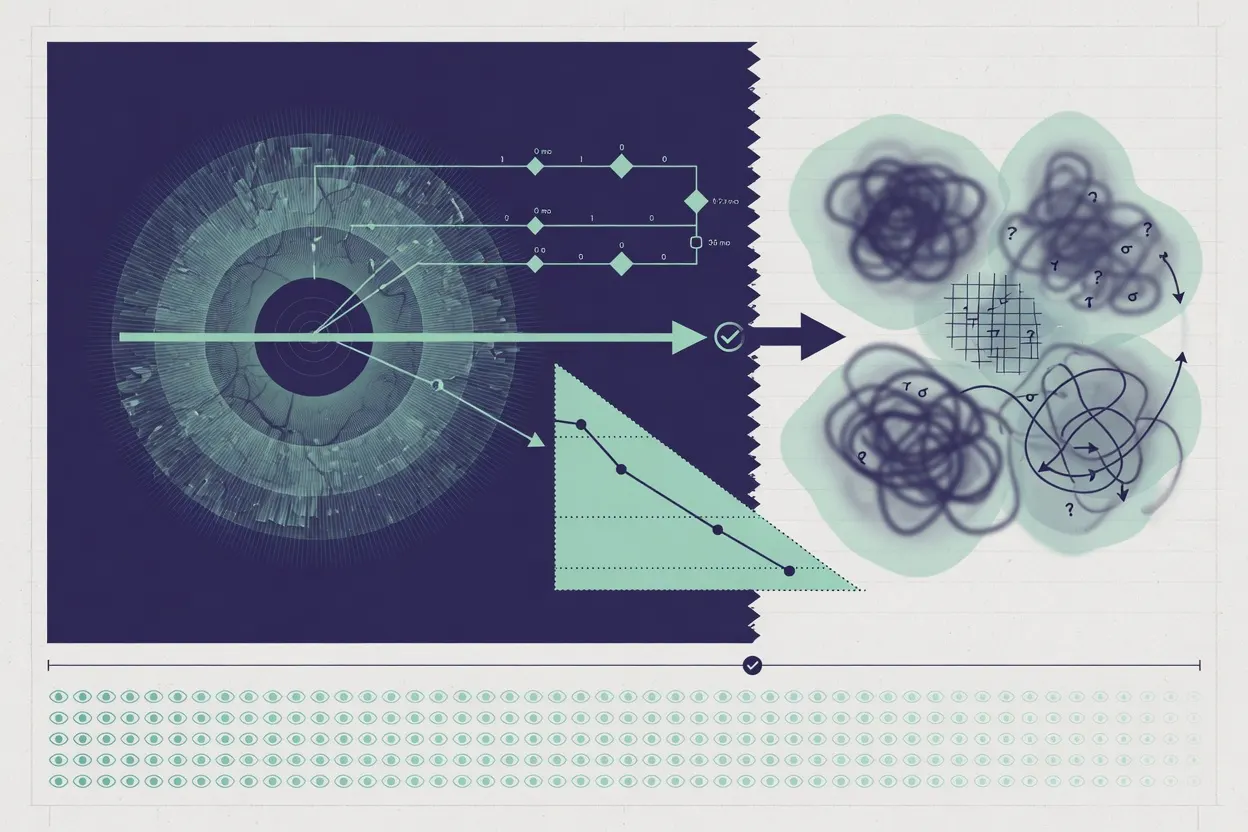
A deterministic, single-pass AI model just outperformed fancier stochastic alternatives at predicting how retinal disease will progress.
Researchers built a diagnostic test to decide whether stochastic, probability-based generative models were worth their complexity for predicting future eye scans, or whether a simpler deterministic model would do the job just as well. They ran the test on fundus autofluorescence images - 24,335 of them, from 9,708 eyes - pulled from a heterogeneous Optos archive spanning irregular follow-up schedules and multiple imaging devices. The diagnostic found that image-to-image change between visits was only weakly tied to elapsed time, meaning the stochastic models weren't producing meaningfully different or useful predictions. So the team built Temporal Retinal U-Net (TRU), a deterministic model conditioned on a patient's imaging history and how far out it needs to predict.
Medical imaging AI has largely chased generative, uncertainty-modeling architectures on the assumption that more randomness captures more of the real biological variability. This study is a case where that assumption didn't pay off: the added machinery bought nothing, because scanner differences and inconsistent visit timing swamped the actual disease signal. TRU still held up best across a held-out cohort and two zero-shot transfer cohorts covering a rare disease and a different vendor's hardware, though its precision dropped in the smaller cross-vendor group.
It's a useful checkpoint for a field that treats "generative" as a synonym for "better" - sometimes the extra complexity is just expensively modeled noise.