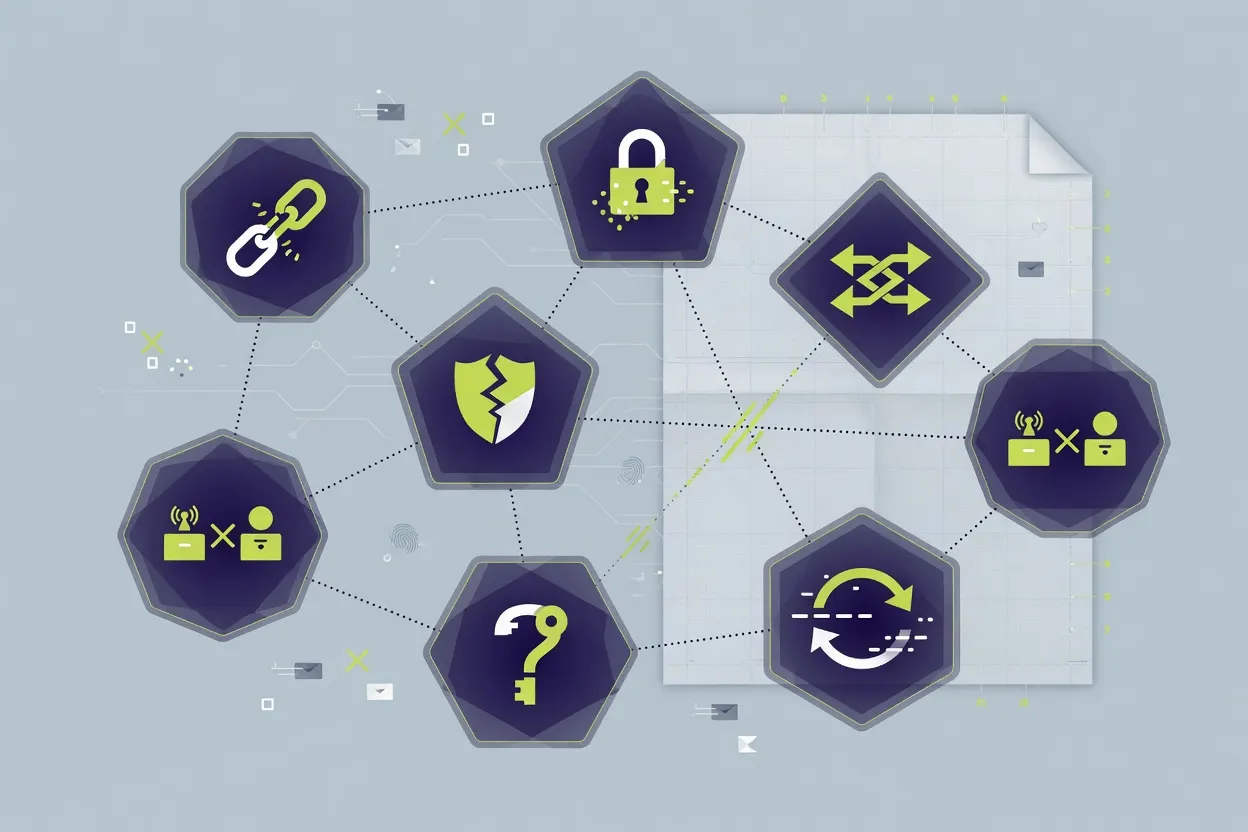
When AI agents start working together across company lines, the security playbook breaks down.
A position paper posted to arXiv identifies seven categories of security challenges that arise specifically when large language model agents cooperate across organizational boundaries. The researchers argue that an agent that behaves safely in isolation can leak sensitive data or violate policy the moment it starts receiving messages from an untrusted peer. The paper covers each challenge with example attacks, proposed evaluation metrics, and directions for future research. The use cases motivating the work include joint disaster response and supply-chain optimization — domains where no single organization holds all the data but all of them need to act in concert.
The core problem is that current alignment and containment techniques were designed for a single-owner model. Once you distribute trust across organizations, the assumptions collapse. Risks here are not classical software bugs — they are emergent behaviors that only appear when agents interact, which makes them harder to reproduce, audit, or patch.
The multi-agent AI space has moved faster than its security research. Major labs have published safety work for individual models, but the cross-domain coordination layer is largely uncharted. This paper does not offer fixes — it maps the attack surface. That is useful groundwork, but it also means the gap between capability and containment is wider than most enterprise AI roadmaps currently assume.