Robot AI models built on vision-language backbones have a depth problem.
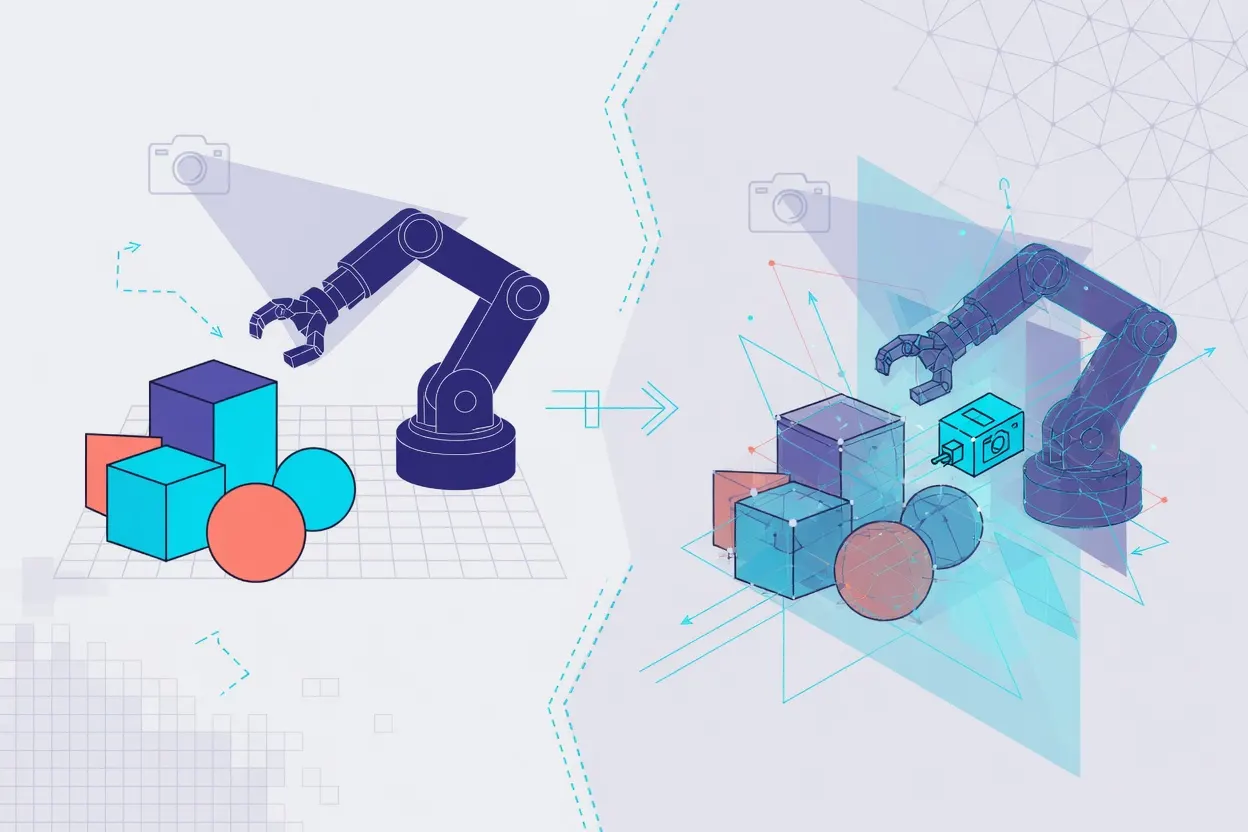
Most vision-language-action (VLA) models process camera images as flat 2D grids — useful for recognizing objects, less useful for knowing where they actually sit in space. A team of researchers has published G3VLA, a plug-in module that feeds calibrated 3D geometry — the kind of spatial data embedded in a camera's physical position and lens parameters — directly into the visual token stream of an existing robot model. The module combines three components: ray embeddings conditioned on camera intrinsics, a projective positional encoding scheme called PRoPE, and a cross-view fusion layer that links multiple camera angles instead of treating them as unrelated images. Crucially, it does not require depth sensors or manual annotations; it can learn geometry from a separate teacher model.
The distinction matters most in multi-camera robot setups, where spatial relationships between views are mathematically known but currently ignored. Tasks that require precise object placement or spatial reasoning — exactly the kind that trip up warehouse robots and lab automation systems — showed the largest gains in tests across four benchmarks. That is a concrete improvement on a concrete failure mode, not a synthetic benchmark win.
The researchers validated the approach on three existing robot models, including Nvidia's GR00T 1.5, and found geometry-aware tokens work best when they feed directly into the action generation layer — a design hint for anyone building the next generation of these systems. The broader field of generalist robot manipulation has moved fast on language grounding; spatial grounding has lagged. G3VLA is an incremental fix, not a redesign, which is both its practical appeal and its ceiling.