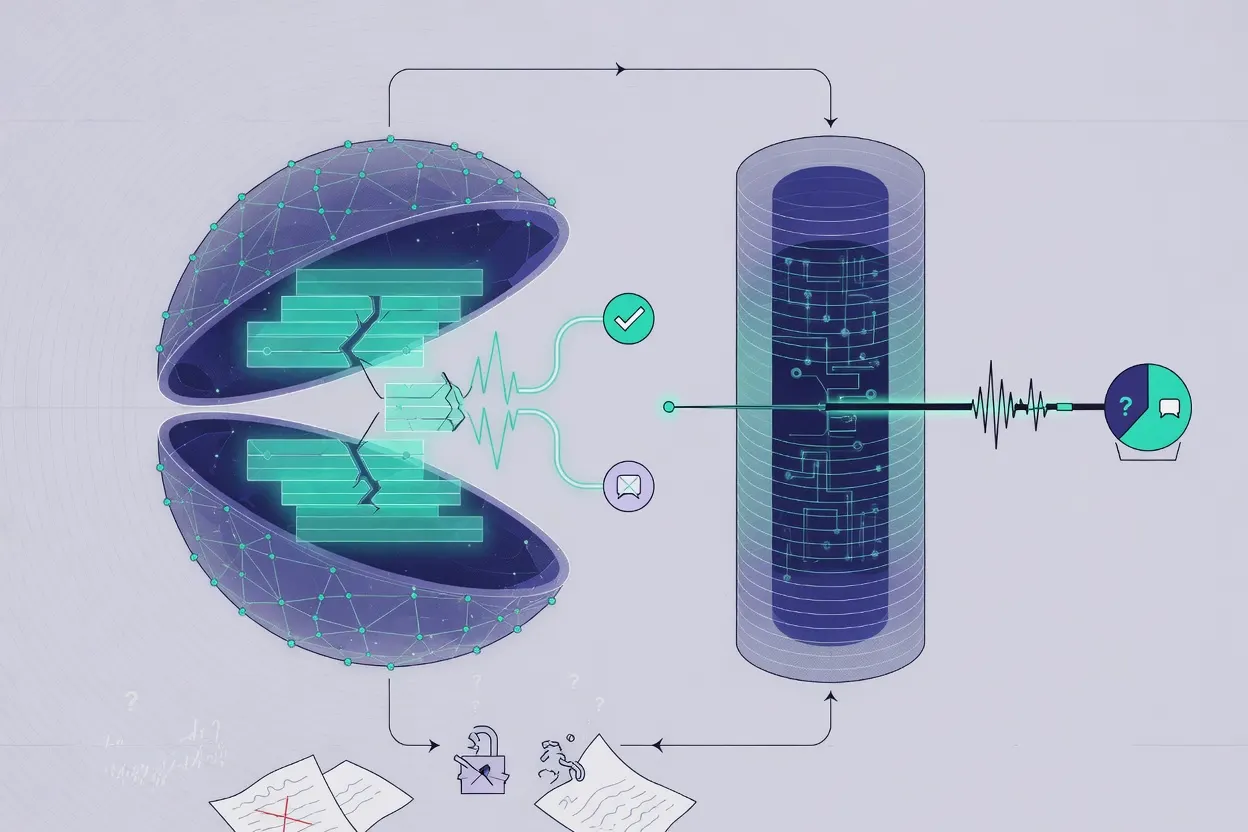
A new probing method claims to catch AI models that know an answer but choose to hide it.
Researchers adapted the Concealed Information Test, a decades-old forensic technique for spotting guilty knowledge in suspects, and pointed it at large language models. The result, called Probe of Internal Recognition (PIR), shows a model a question alongside several candidate answers and reads its internal states to see which one it recognizes as correct - no honest reference model or labeled answer key required. Tested on eight models across five families, including Gemma, Qwen, Llama, Mistral, and Phi, PIR identified the recognized answer with 70 to 87 percent balanced accuracy, well clear of a 25 to 40 percent baseline for guessing on unknown items. The signal held even when models were deliberately made to conceal answers, through prompted deception, trained sandbagging, or password-locked and circuit-broken checkpoints, reaching 85 to 93 percent recognition in those cases.
The useful part is the contrast. When researchers actually erased a model's knowledge through unlearning, PIR's recognition score fell to the same level as a question the model never knew in the first place. That means the method can distinguish a model that won't answer from one that genuinely can't - a distinction capability evaluations have struggled with, since a model that strategically underperforms a dangerous-capability test looks identical, from the outside, to one that's simply not capable.
It's an audit tool, not a public verification system. PIR needs access to a model's internal weights, so it's a check available to whoever trains the model - not to outside regulators or users trying to confirm what a lab claims about its own system.