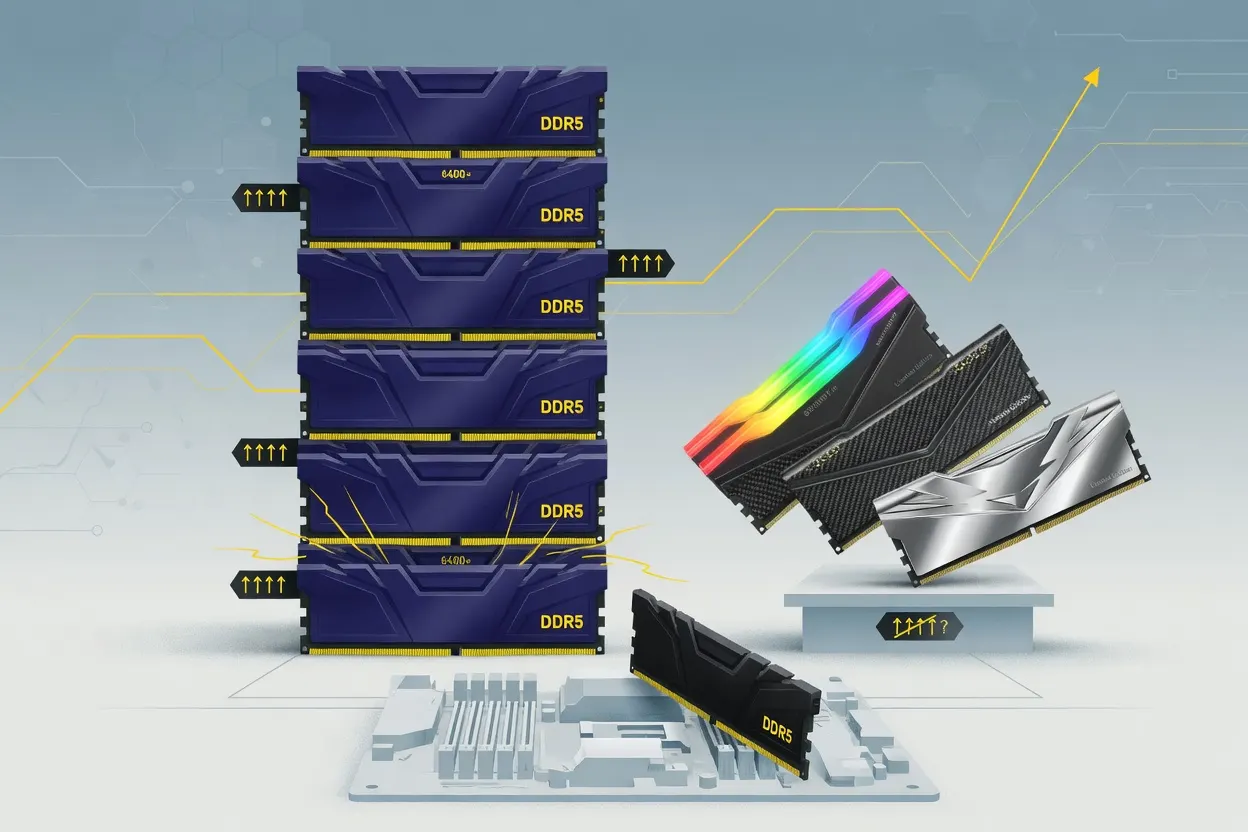
RAM is going to stay expensive for years, and the companies that sell it are either ignoring the problem or releasing ultra-fast memory barely anyone can use.
Lenovo, presenting at a high-performance computing event last week, warned that DRAM prices will remain elevated for years and may never return to 2024 levels. Rather than responding by making affordable, slower kits more accessible, memory makers like G.Skill, Geil, and Team Group have been announcing DDR5-8000 and DDR5-9200 kits, extreme speeds tethered to Intel's LGA 1851 platform and useful in only a narrow slice of workloads. Kingston and Lexar, meanwhile, have gone quiet on the whole subject. The fast kits use a clock-boosting chip (CUDIMM) that only works with specific Intel Arrow Lake processors, and even then, only the latest 200K Plus chips natively support DDR5-7200.
For most PC builders, this is the wrong direction entirely. On AMD Ryzen X3D platforms, even DDR5-5200 CL38 barely moves the needle in games, because memory bandwidth rarely bottlenecks frame rates. The sweet spot on AM5 is DDR5-6000 with a CAS latency of 32 cycles, and the gap between that and DDR5-9200 is invisible unless your CPU and GPU have run out of other work to do.
The argument for releasing exotic kits anyway is that memory is the core business for G.Skill and Geil, so they need headlines even when the headlines don't help buyers. But if prices stay punishing and nobody fields relief at the affordable end, some brands synonymous with PC gaming memory for decades may not outlast the squeeze.