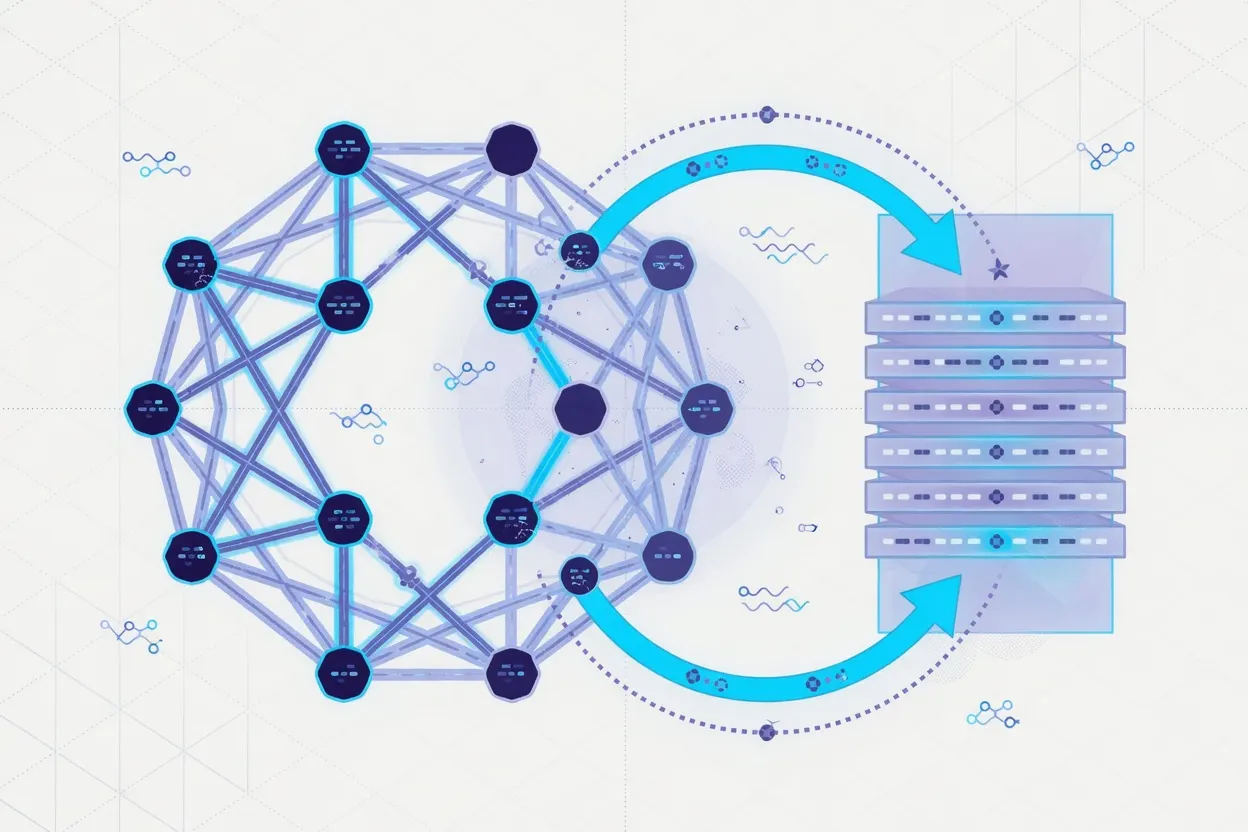
A research framework called PromptGNN-sim proposes a tighter, two-way coupling between graph neural networks and large language models for learning on text-rich graphs.
Most existing approaches treat graph structure and text as separate inputs, passing one to the other in a single direction. PromptGNN-sim instead runs the connection both ways. A Graph Attention Network selects neighboring nodes using both structural position and textual similarity, then feeds that context into an LLM as structured prompts — including node summaries, label categories, and keywords from similar neighbors. During training, cross-modal contrastive learning and cross-attention jointly update both components so neither side is frozen while the other adapts.
The approach matters because text-attributed graphs — networks where nodes carry text descriptions, common in academic citation data, Wikipedia, and biomedical literature — are notoriously hard to generalize across. When connectivity is sparse or the model is asked to transfer to a new dataset, shallow fusion methods degrade quickly. The researchers tested PromptGNN-sim on six public benchmarks, including Cora, Pubmed, and WikiCS, and report it outperforms both standalone GNNs and LLMs as well as recent hybrid methods on accuracy, cross-dataset generalization, and robustness under sparse perturbations.
The paper is a preprint, so independent replication is still pending — but the framing of bi-directional fusion as a solution to shallow pipelines is a reasonable critique of how most GNN-LLM work has been structured so far.