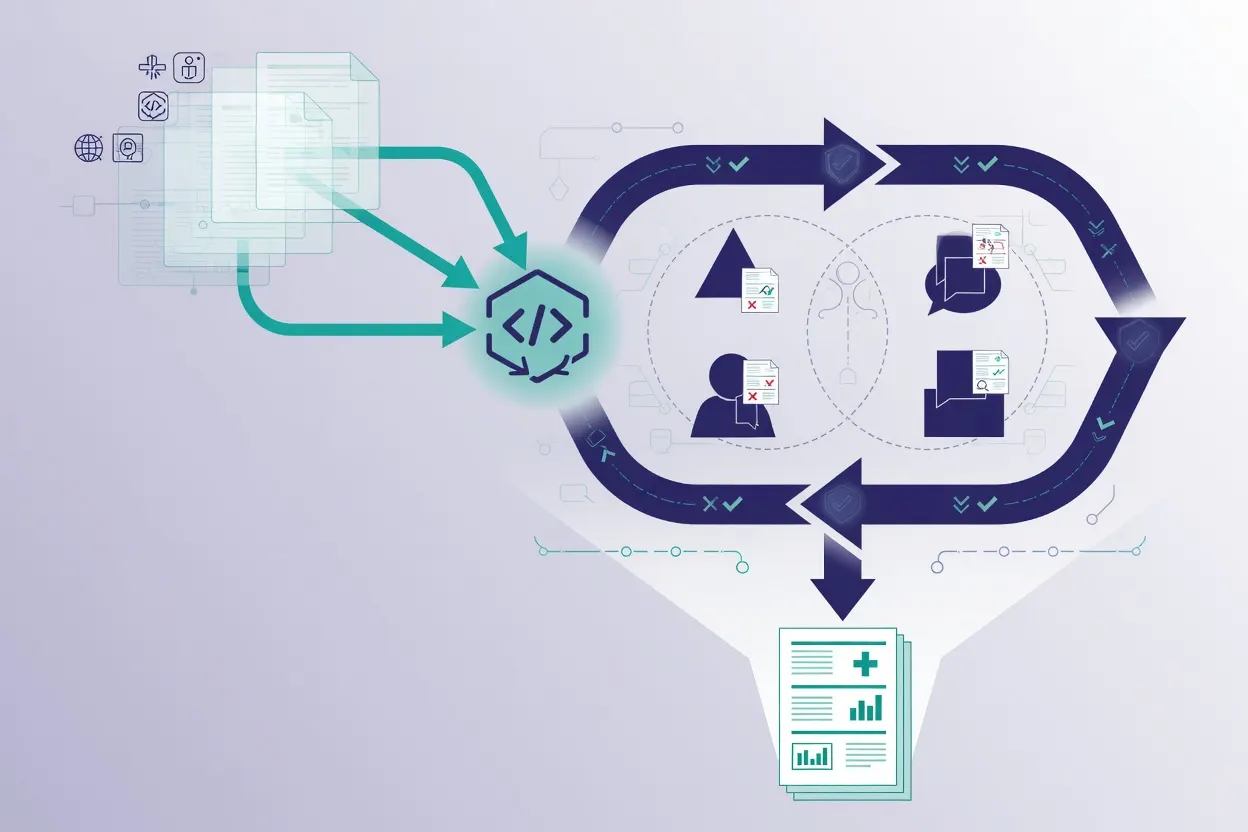
A new open-source platform wants to make AI-assisted medical research auditable instead of a black box.
DEEPMED Search, released on arXiv, is a web-based agentic tool built on Next.js that breaks a medical query into sub-questions and routes each one to the most relevant source — PubMed for academic literature, general web search for clinical guidelines, or a local graph-based knowledge base for private data. The twist is an "introspective verification" step: before the system synthesizes an answer, a multi-agent debate module checks the retrieved evidence against diagnostic logic to flag contradictions or confounds. The researchers demonstrated it on rare-disease queries, where long-tail information gaps tend to trip up simpler retrieval systems.
The verification layer is the meaningful differentiator here. Standard retrieval-augmented generation pipelines pull documents and summarize — they do not interrogate whether the retrieved evidence actually supports the conclusion. For high-stakes medical questions, that gap matters. Making the whole pipeline open-source also lets hospital IT teams and researchers audit exactly what the model is doing, which commercial tools like Perplexity or closed clinical AI products do not allow.
The paper is careful to scope this to research and prototyping, not clinical deployment — a reasonable caveat given that no independent benchmark against existing medical AI tools is included. Whether the debate framework actually reduces hallucinations at scale, or just adds latency, remains an open question.