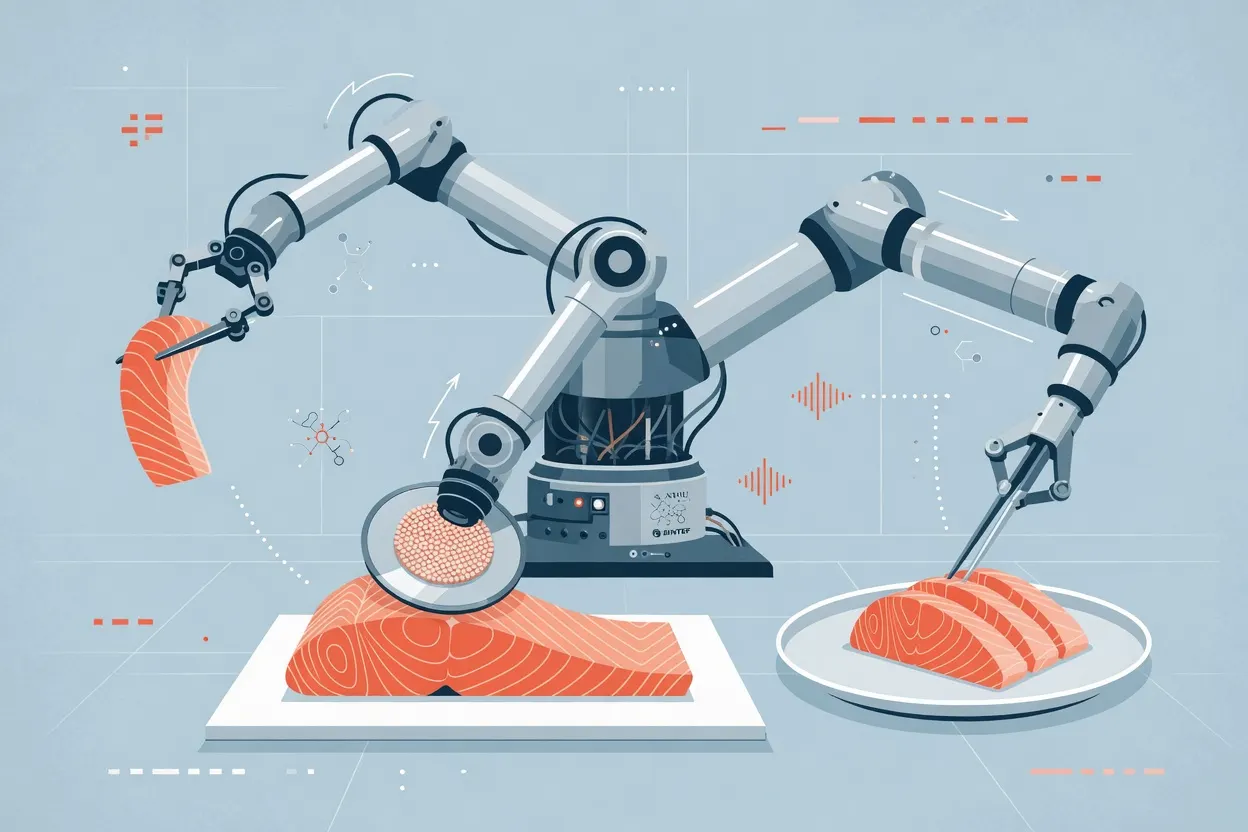
A Norwegian research team has built a three-armed robot that slices and serves salmon sashimi without needing a human hand on the knife.
The robot relies on AI training and three coordinated arms to handle the fish. A tactile sensor tells the system exactly when the blade touches the cutting board, which is the mechanical detail that separates a usable result from a mangled one. Without that feedback, a robot risks inconsistent slices and unpredictable force on the surface. The team built and tested the system specifically on salmon.
Fine knife work has remained one of the harder problems in food automation. Industrial fish processing is already partly automated, but producing consistent, restaurant-quality cuts requires the kind of tactile judgment that cameras and timers alone cannot provide. A robot that can feel its own contact points and adjust in real time shifts that calculus, at least in a lab setting.
Whether this leaves the research stage depends on questions the paper does not address: cost, cycle time, sanitation compliance, and whether a three-armed system can survive the pace and grime of a real kitchen. Norwegian salmon is a major export industry, so there is commercial logic in automating the prep work. But a working research prototype is not a product roadmap.