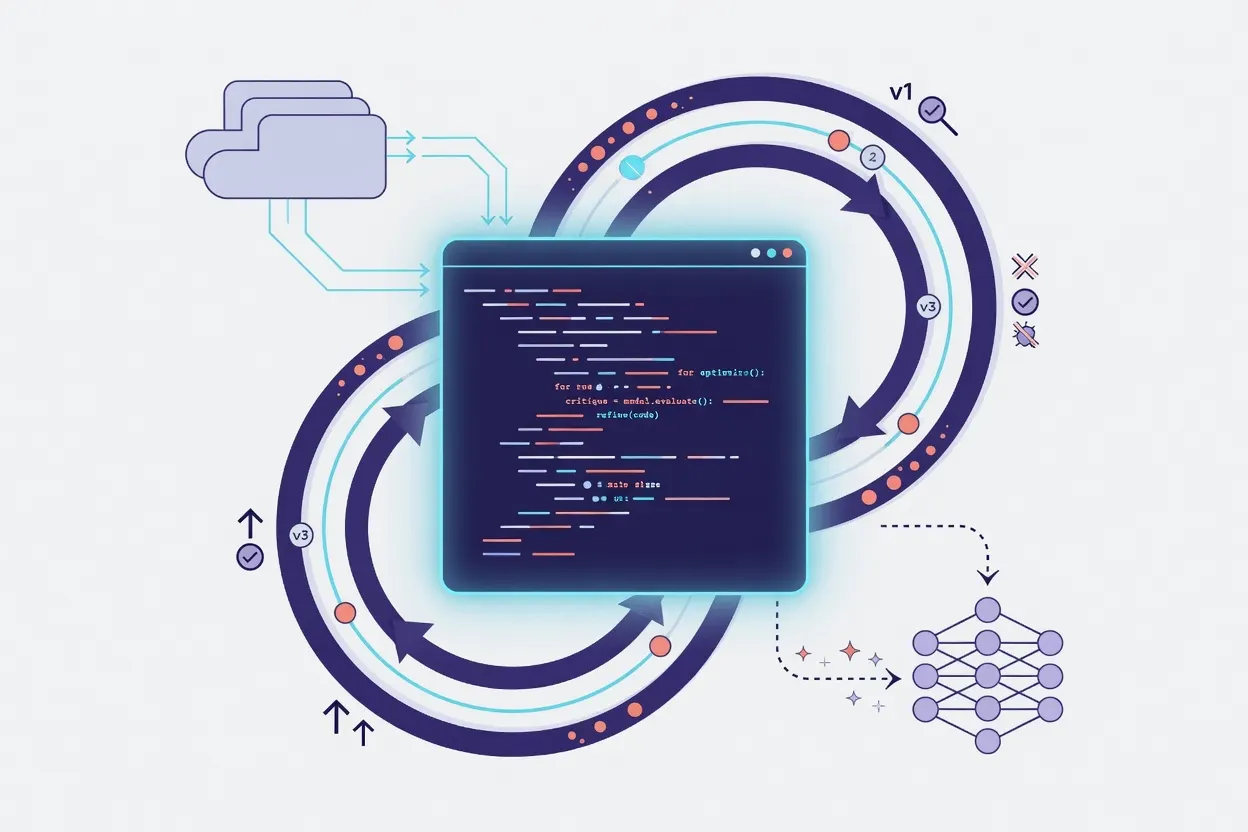
A new framework teaches AI models to get better at coding by grading their own repeated attempts, not just their final answer.
Researchers built MetaEvolve, a training pipeline that targets what they call meta-skills: the ability to reflect on feedback and refine a solution over several rounds, rather than produce one correct answer on the first try. The system generates evolution trajectories, each pairing a program with a fitness score covering both correctness and efficiency, plus a record of earlier attempts, then trains the model with reinforcement learning using rewards pulled straight from running test cases. Across seven coding benchmarks, MetaEvolve beat the strongest baseline by 10.01 percentage points on tasks similar to its training data and by 24.12 points on tasks outside it. On open-ended algorithm optimization problems it had never trained on, the gain reached 46.9% relative improvement.
The interesting claim here isn't the benchmark score, it's the premise: that self-evolution is a trainable skill separate from raw coding ability, and that drilling it on code, where test execution gives cheap, reliable feedback, might transfer to domains where good feedback signals are hard to come by. That would matter for any AI system meant to iterate on its own work with minimal supervision, from AlphaEvolve-style discovery tools to coding agents left running unattended.
Still, every number in this paper comes from coding tasks with built-in test feedback. Whether the transfer to messier, reward-scarce domains actually holds is, for now, an assumption the researchers are asking us to take on faith.