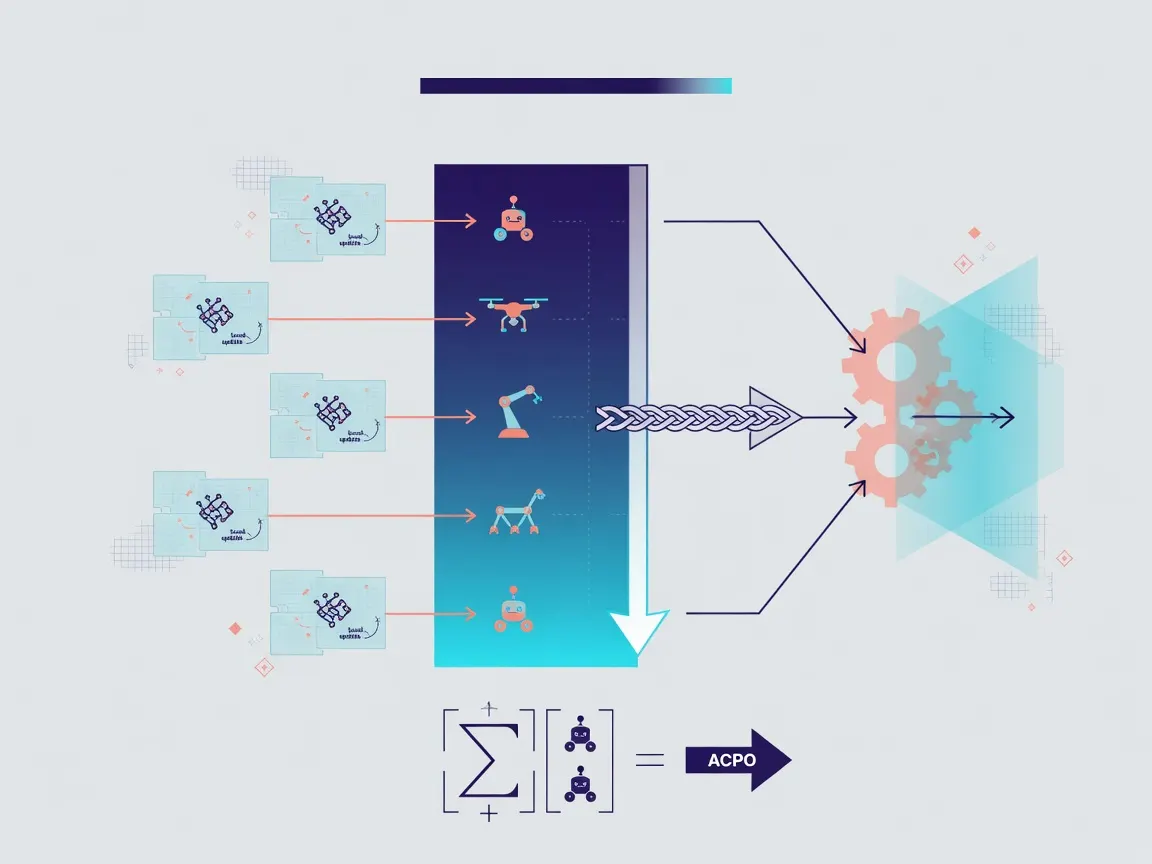
A new multi-agent reinforcement learning algorithm claims to solve a coordination problem that has dogged the field for years.
Researchers introduced Agent-Chained Policy Optimization (ACPO), a training method for cooperative AI agents that need to maximize a shared goal. The core insight: the joint policy gradient - the mathematical signal that tells all agents how to improve together - can be broken into exact per-agent pieces without losing the joint-improvement guarantee. Each agent trains independently, but a serialized decision model has each agent condition its action on a "belief" about what the agents before it chose. That belief is the coordination glue. In benchmark tests across Multi-Robot Warehouse, SMACv2, and MA-MuJoCo, ACPO beat existing baselines, and the margin widened as more agents were added.
The two dominant approaches before this work both had uncomfortable tradeoffs. Methods that factor updates independently require value decomposition assumptions that may not hold in practice. Methods that alternate best-response updates risk locking into suboptimal Nash Equilibria - stable states where no single agent wants to deviate, but the group could collectively do better. ACPO sidesteps both failure modes by keeping the full joint gradient while still running decentralized.
The scaling result - performance advantage growing with agent count - is the number to watch. Most MARL papers show decent two-to-four agent results and then quietly avoid the ten-or-twenty-agent case. If ACPO's scaling claim holds under adversarial conditions and real-world noise, it matters; if it only holds on clean simulation benchmarks, it joins a long list of methods that looked good on paper.