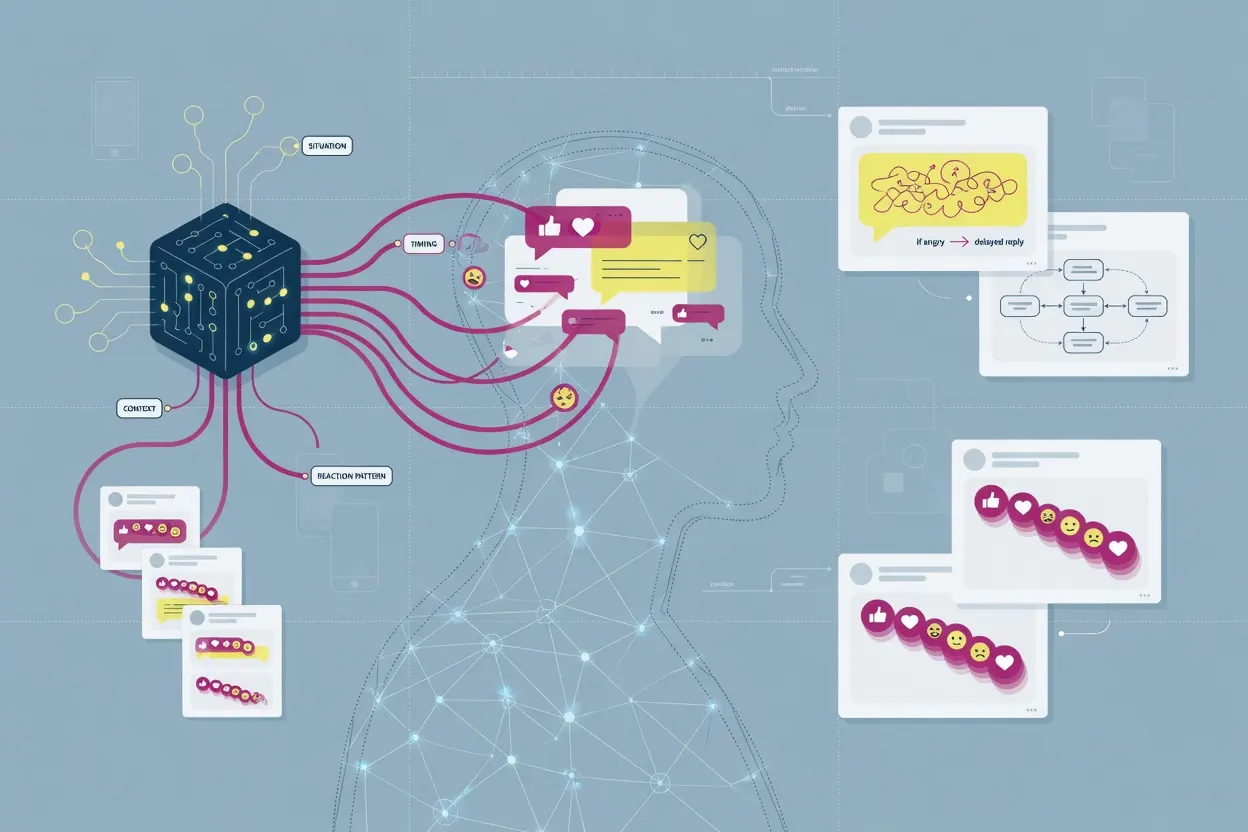
A new AI framework tries to make chatbots react like the specific person they're imitating, not just echo how that person talks.
Researchers built a method called Situation-Internal state-Behavior persona, which generates replies by modeling how a person's internal state and the situation they're in shape their behavior, rather than leaning on in-context learning that just feeds a model examples of past posts. Tested on a newly built dataset of social media replies, the method beat existing in-context learning baselines. Because it's hard for an LLM judge to grade an impersonation of someone it doesn't already know well, the team also built an evaluation protocol that hands the AI judge reference material about the person being impersonated; that protocol, not the impersonation method itself, is what achieved moderate correlation with human judgment. The method also held up on fictional-character benchmarks, suggesting the behavioral approach isn't limited to real people's social posts.
The real problem here is familiar to anyone who has used an AI persona bot: it can recite someone's opinions but still feels off because it doesn't react the way that person would under pressure or in context. Fixing the evaluation side may matter more than the modeling trick, since it's been genuinely hard to score these systems when the judge can't independently verify facts about an obscure person.
Moderate correlation with human judgment is a modest result, and a benchmark built by the same team that built the method is worth watching rather than taking at face value.