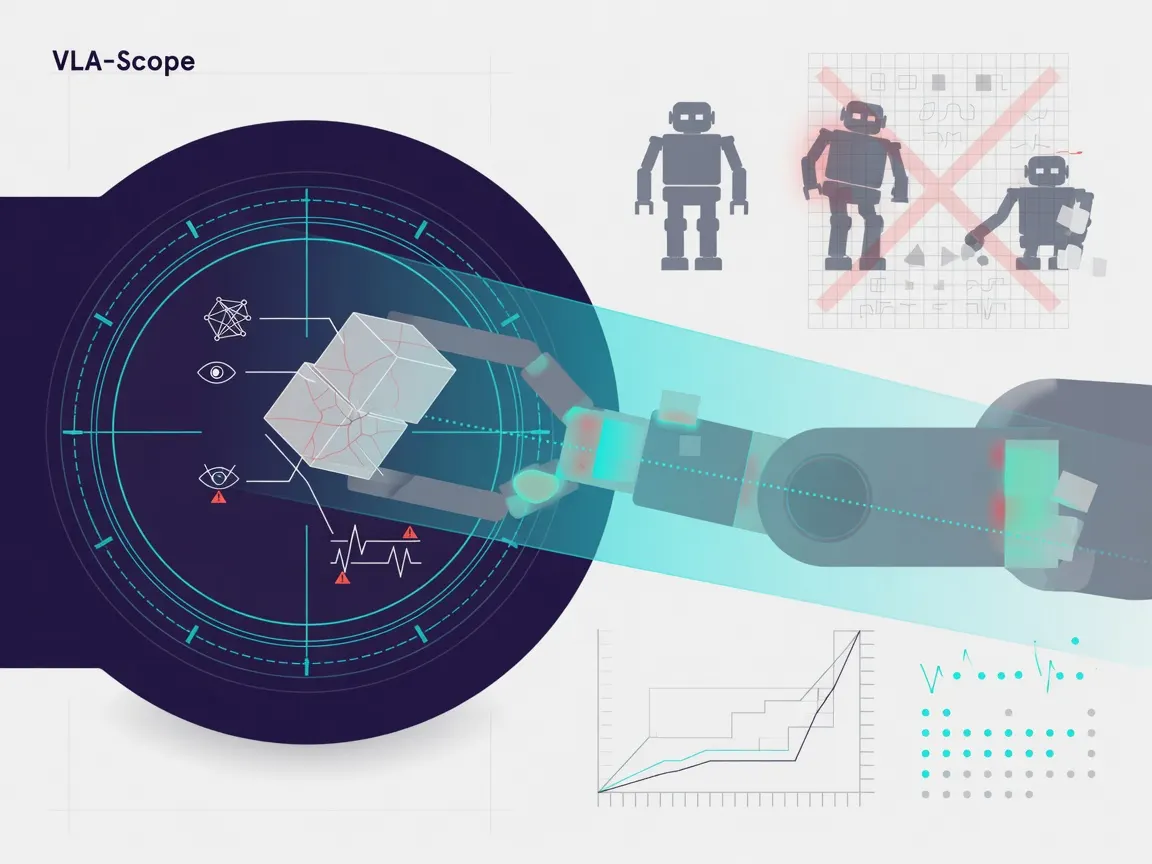
A new framework predicts when a robot's AI brain is about to fail, before it makes a costly mistake.
Researchers built VLA-Scope, a two-stage system for vision-language-action (VLA) models, the AI systems that turn camera images and typed instructions into robot movements. The first stage flags when a robot's input looks unfamiliar, or out-of-distribution, and sorts why. The second stage watches the robot's actions and progress as it works to estimate the odds of failure in real time. Tested on OpenVLA across ten LIBERO-Spatial tasks, the system detected out-of-distribution inputs with a 0.9454 ROC-AUC and classified shift types with 91% accuracy; after 60 actions, failure prediction hit 0.8497 ROC-AUC, beating two existing baselines.
Robots don't fail just because their surroundings look different - they fail unpredictably even then, so spotting an odd input isn't the same as knowing the robot is about to screw up. VLA-Scope's trick is combining that shift detection with a live read of how the action is unfolding, a distinction that matters for anyone trying to let a robot arm run unsupervised near people or expensive equipment.
The results come from one model on ten lab tasks, not a warehouse floor, so treat an 0.85 ROC-AUC as a promising benchmark score, not a safety guarantee.