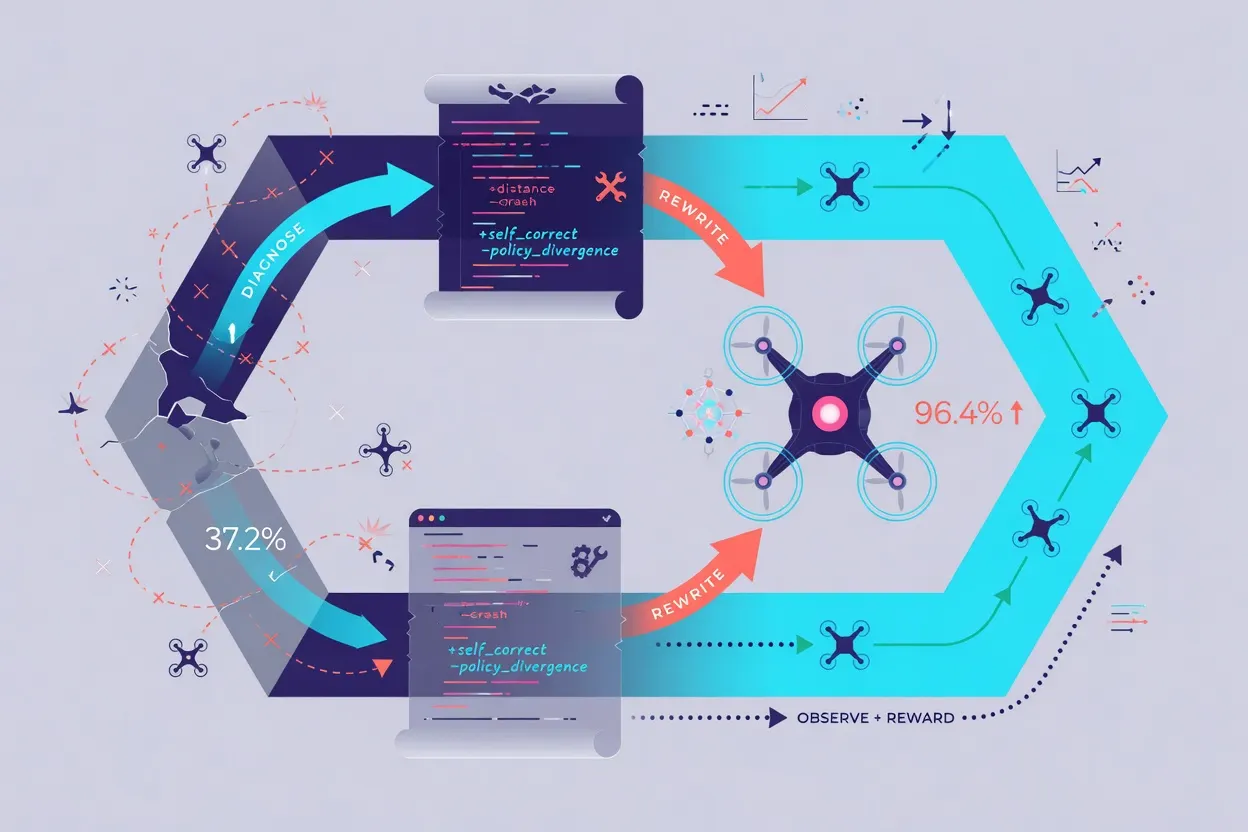
A new reinforcement learning framework lets drones critique their own training rewards and rewrite them automatically.
Researchers built AgenticRL, a closed-loop system where specialized AI agents write reward functions for drone flight, train a policy with PPO, then diagnose what went wrong using behavioral, geometric, and safety data plus visual scene context. The system generates targeted refinement instructions and regenerates the reward, repeating the cycle without human intervention. Tested across eight UAV tasks including racing, obstacle avoidance, and cluttered flight, the approach hit 100% success in racing and 88% in cluttered navigation, beating the Eureka and Text2Reward baselines on those respective tasks. Reward refinement lifted average simulated success from 37.2% to 96.4%, and the resulting policies worked in the real world 90% of the time.
Reward design is the tedious, error-prone bottleneck of reinforcement learning - get it wrong and a robot learns to game the metric instead of the task. Automating not just reward generation but the diagnosis of why a reward failed is a real step toward RL systems that debug themselves, which matters more as robots move from simulation into messier real-world deployment.
This is still one research group's benchmark on its own task set - the real test is whether the diagnostic loop holds up outside curated UAV scenarios.