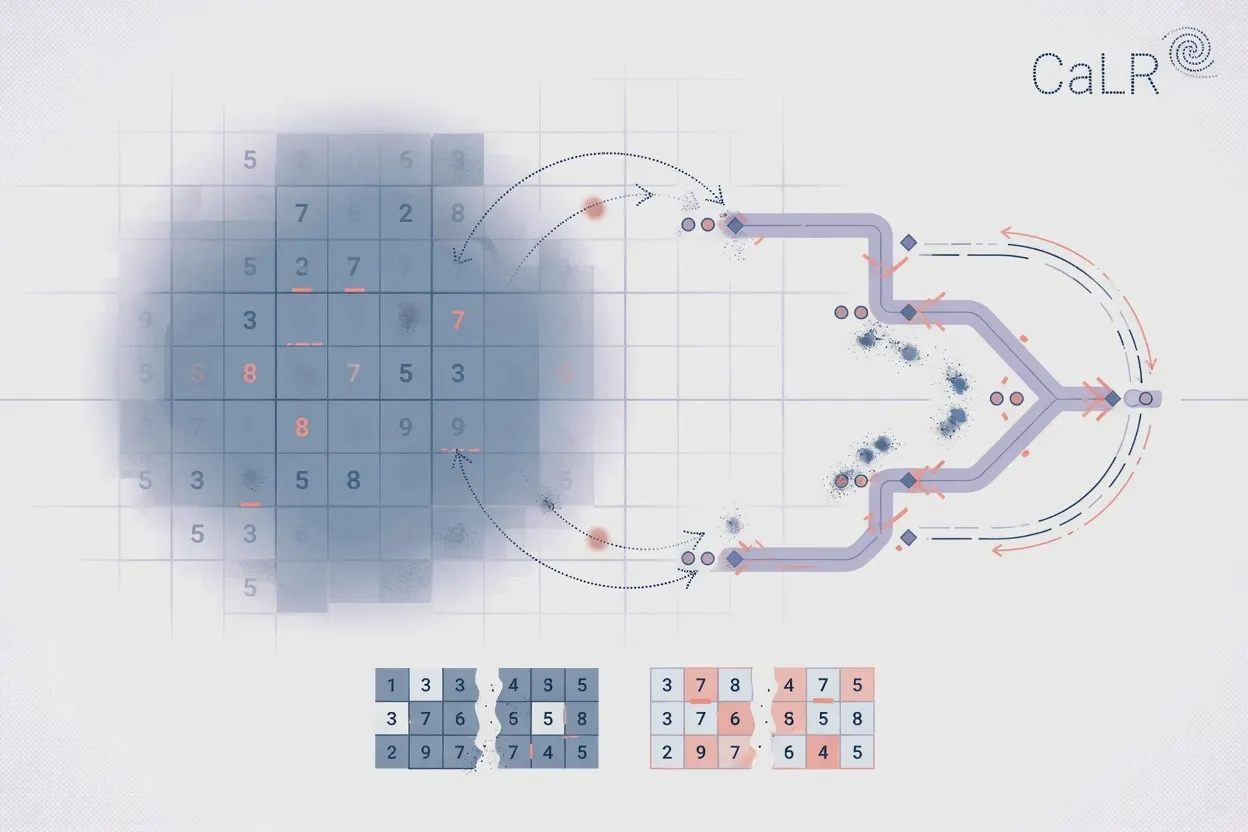
A new training method lets AI models that generate text all at once catch and fix their own reasoning errors mid-answer, instead of only after they are done.
Researchers built a system called Causal Latent Revision, or CaLR, that targets diffusion language models. Unlike standard chatbot models, which write one word at a time in strict left-to-right order, diffusion models draft an entire response at once and refine it through repeated passes. That parallel approach is fast, but it has historically made these models sloppy at multi-step logic, since nothing forces an early guess to stay consistent with a later one. CaLR fixes this by borrowing a map of which reasoning steps depend on which others, called a causal topology matrix, from an already-trained expert model, then using that map to nudge the diffusion model's internal draft toward logical consistency as it generates. In tests, CaLR beat both older diffusion models and standard left-to-right models on complex reasoning benchmarks, including Sudoku puzzles that require every step to be internally consistent.
The result matters because it chips away at diffusion models' biggest weakness relative to today's dominant chatbot architecture. If parallel-generation models can match or beat step-by-step models on logic while keeping their speed advantage, that reshuffles the tradeoffs product teams weigh when picking an architecture for reasoning-heavy tools like coding assistants or planners.
Sudoku is a tidy benchmark precisely because it has clean, checkable rules. Real-world reasoning is messier, and this is a single paper, not a shipping product, so treat the SOTA claim as a promising lab result rather than a settled fact.