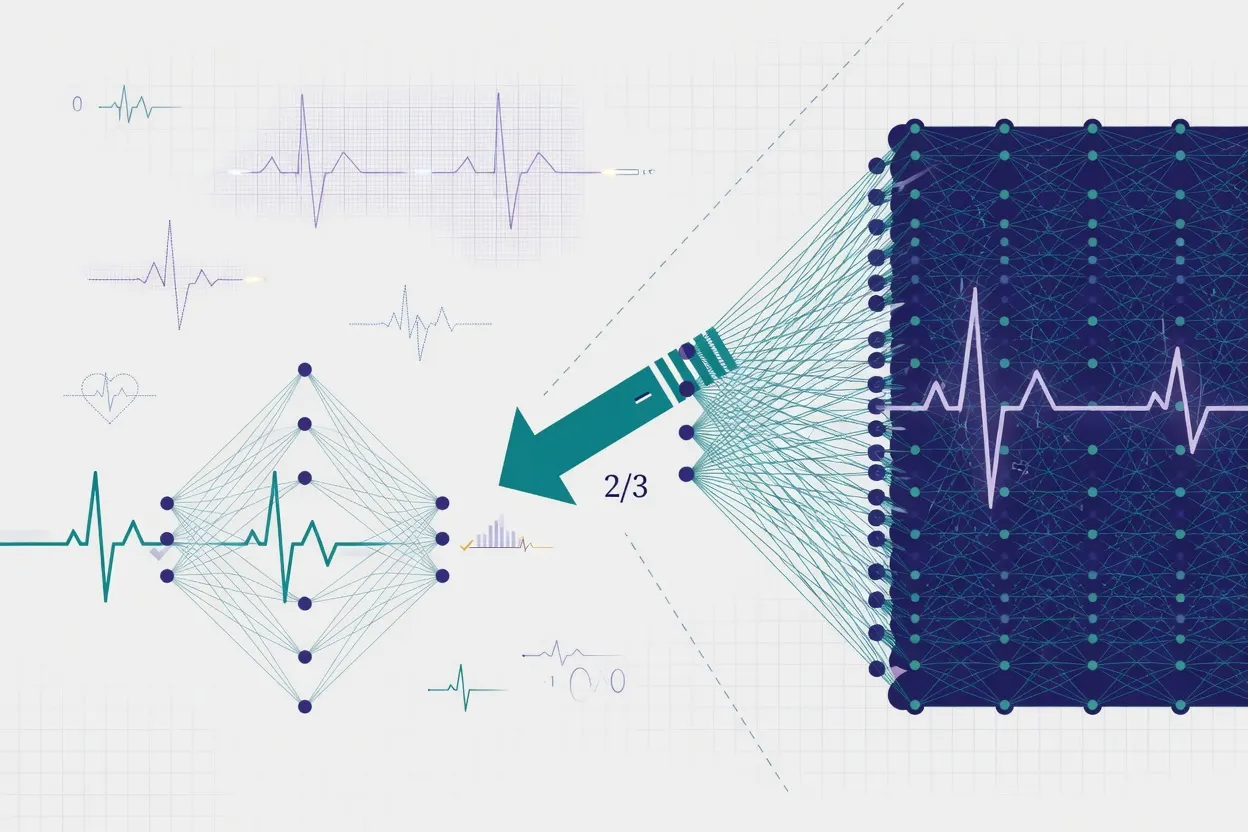
A new ECG-reading AI model matches top-tier diagnostic accuracy while using a third of the parameters and far less training data.
Researchers built BEAT-Net, a model designed to read heartbeats the way a cardiologist does rather than treating an EKG as generic pixels or a raw time series. It slices recordings into individual heartbeats centered on the QRS complex, then runs them through four stages that extract shape, normalize across leads, add timing context, and reason globally with a transformer. Tested on three benchmarks - PTB-XL, CPSC2018, and CSN - BEAT-Net hit 0.924 AUC, essentially tied with dominant CNN models at 0.925 AUC, but needed only 0.7 million parameters against a CNN baseline's 2.06 million, a 66 percent cut. It also reached CNN-level performance using just 35 percent of the training data those models typically require.
The sharper result is what happened against HeartLang, a 39.5-million-parameter foundation model built on the bigger-is-better playbook: BEAT-Net beat it on morphological Form classification, 0.901 AUC to 0.832. That's a real dent in the assumption driving most medical AI right now, that scale is the fastest route to accuracy. Baking in known physiology looks like it can out-perform brute-force pretraining, at least for signals like ECGs whose structure researchers already understand well.
It's one paper, not a bedside product, but it's a rare case where the more interpretable model is also the leaner one - usually you have to pick.