A new reinforcement-learning method called Deep-BQRL makes risk-aware AI training practical outside toy examples.
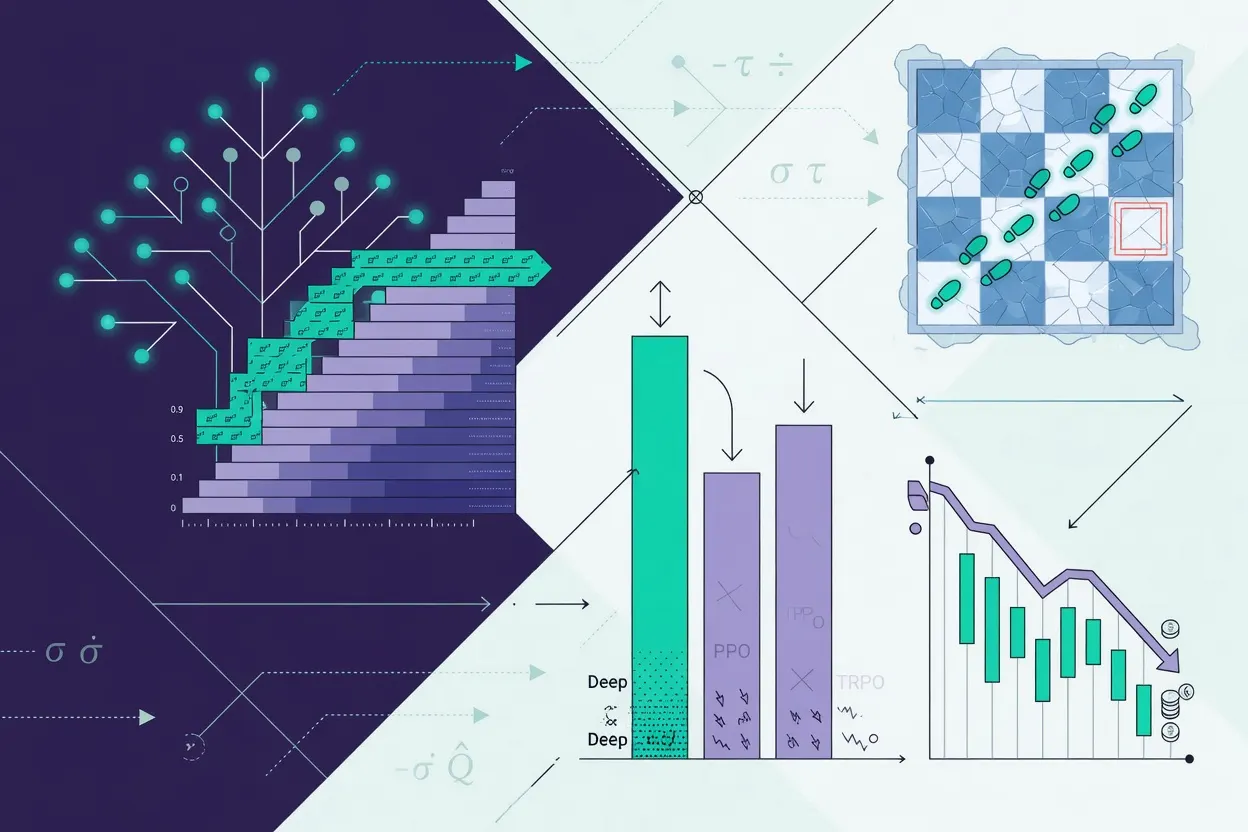
Researchers built Deep-BQRL to solve a specific headache in quantile-based reinforcement learning: teaching an AI to optimize for a specific risk level, like the 10th-percentile outcome instead of the average, without the training signal becoming unstable. Earlier fixes for this instability, called buffered quantiles, worked by smoothing out the target with its neighbors, but they only worked in small, model-based, tabular setups. Deep-BQRL adapts that smoothing trick to neural networks, learning the return distribution directly from sampled transitions rather than requiring an explicit model of it. The team tested it on an asset-selling problem and a slippery version of the FrozenLake game, comparing it against tabular PPO, TRPO, and a model-based baseline called UCB-BQRL.
This matters because most reinforcement learning optimizes for average performance, which is a bad fit for anything where a rare, catastrophic outcome matters more than the typical one -- trading, medical dosing, autonomous vehicles. Making quantile-based objectives work with standard neural function approximation, rather than small lookup tables, is what would let this risk-sensitive approach actually reach real-world systems instead of staying a research curiosity.
The results are a partial win: Deep-BQRL beat PPO and TRPO on policy accuracy, but the older, model-based UCB-BQRL still edged it out. In other words, the model-free version is more scalable, not yet better -- the usual trade-off when you swap an exact planner for a learned approximation.