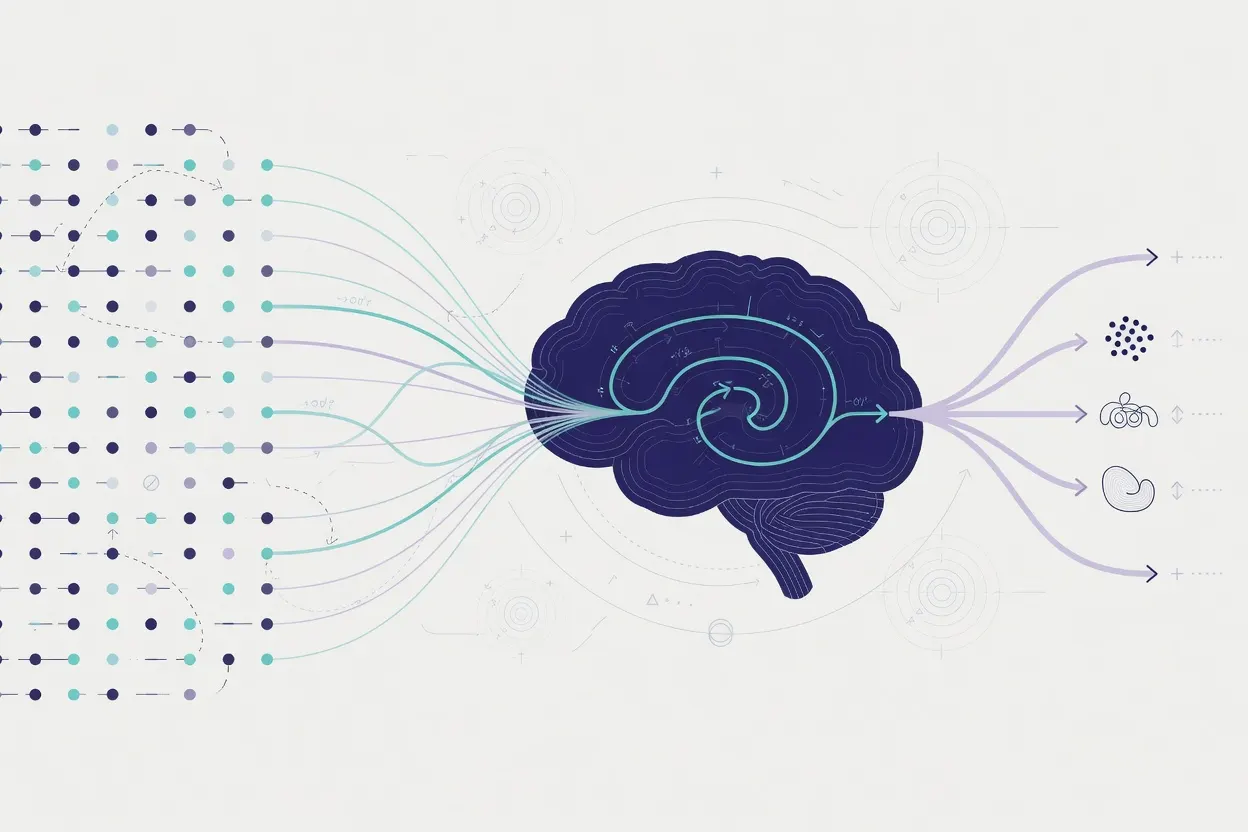
A research team has published ENC-ODE, a machine learning model designed to forecast the progression of Alzheimer's disease biomarkers over time using neural ordinary differential equations.
The core problem ENC-ODE targets is a familiar one in clinical research: longitudinal patient data is expensive to collect, burdensome for patients, and almost always incomplete. Standard sequence models struggle when observations are sparse or arrive at irregular intervals. ENC-ODE sidesteps this by modeling clinical events in continuous time rather than discrete steps, conditioning its dynamics on a patient's diagnosis and using a target-conditioned attention mechanism to weight event-level predictions without compressing prior history. The team tested it on the Alzheimer's Disease Neuroimaging Initiative dataset and reports it outperforms representative sequence model baselines.
The significance here is less about a single accuracy number and more about the architectural choice. Continuous-time models are better suited to real clinical workflows, where a patient might get one scan in year one and three in year four. If the approach generalizes, it could give clinicians a more reliable picture of where a patient is headed before symptoms become obvious — the window where interventions matter most.
The code is public on GitHub, which is the right call for a research claim this specific; reproducibility is the only thing standing between a promising arXiv preprint and something a clinician might one day trust.