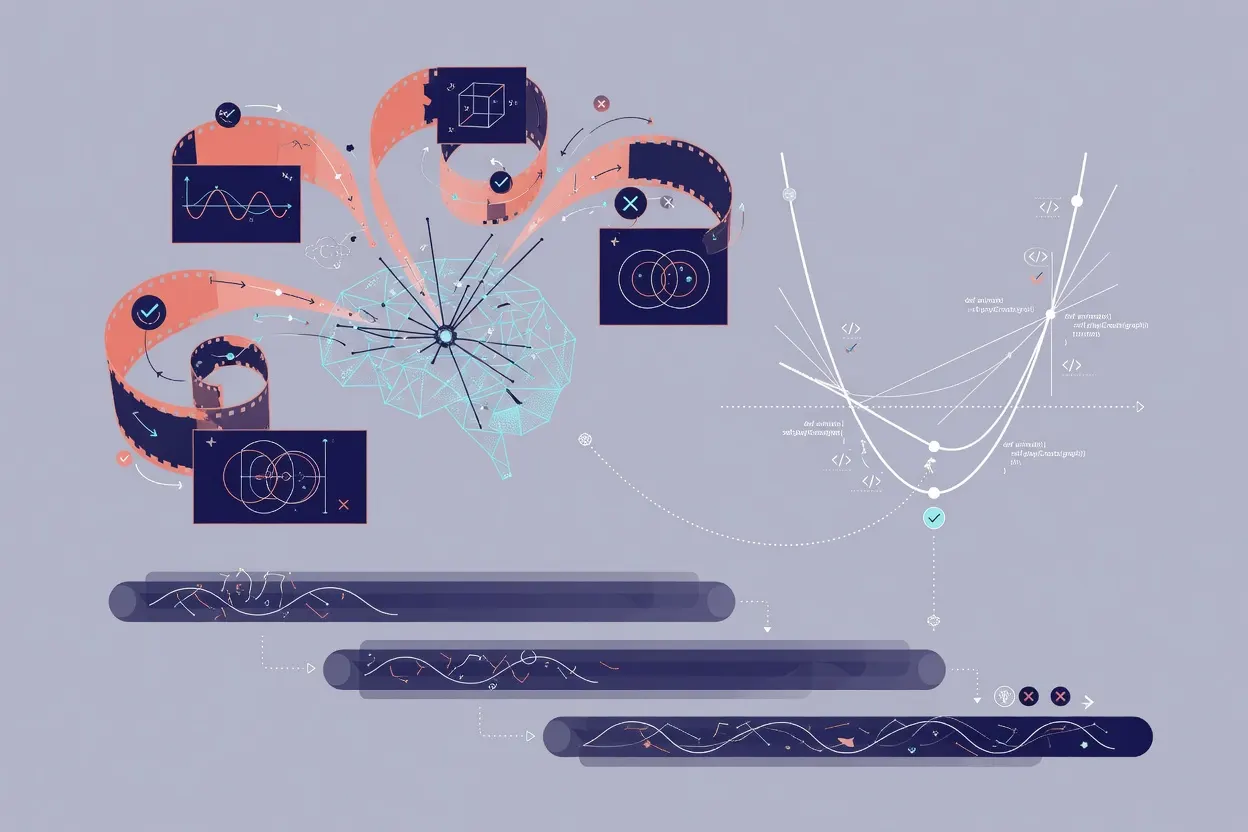
An AI agent that learns from its own track record — not from human-curated data — can now produce improving mathematical animations with less trial and error each time.
Researchers introduced ManimAgent, a system built on large language models that generates Python code for the open-source Manim animation library. The twist: instead of treating each task as a fresh start, the agent keeps a dual-channel memory bank. One channel logs what worked — stored as soft reference examples. The other logs what failed — stored as hard known pitfalls. A vision-language model scores the rendered animation frames after each task, and those scores decide which channel gets updated. No human seeds the memory; no model weights change.
Most reflection-capable agents are amnesiac by design — they iterate within a single task, then reset. ManimAgent's value proposition is continuity: the longer it runs, the more its memory bank grows, and the better its first-attempt success rate gets. In blind human evaluations, Pass@1 scores rose and the number of reflection rounds needed fell as memory accumulated — a meaningful signal that cross-task learning is doing real work.
The practical ceiling here is still unclear. Manim is a niche, well-defined domain; whether this dual-channel memory approach scales to messier code-generation tasks is an open question the paper does not answer.