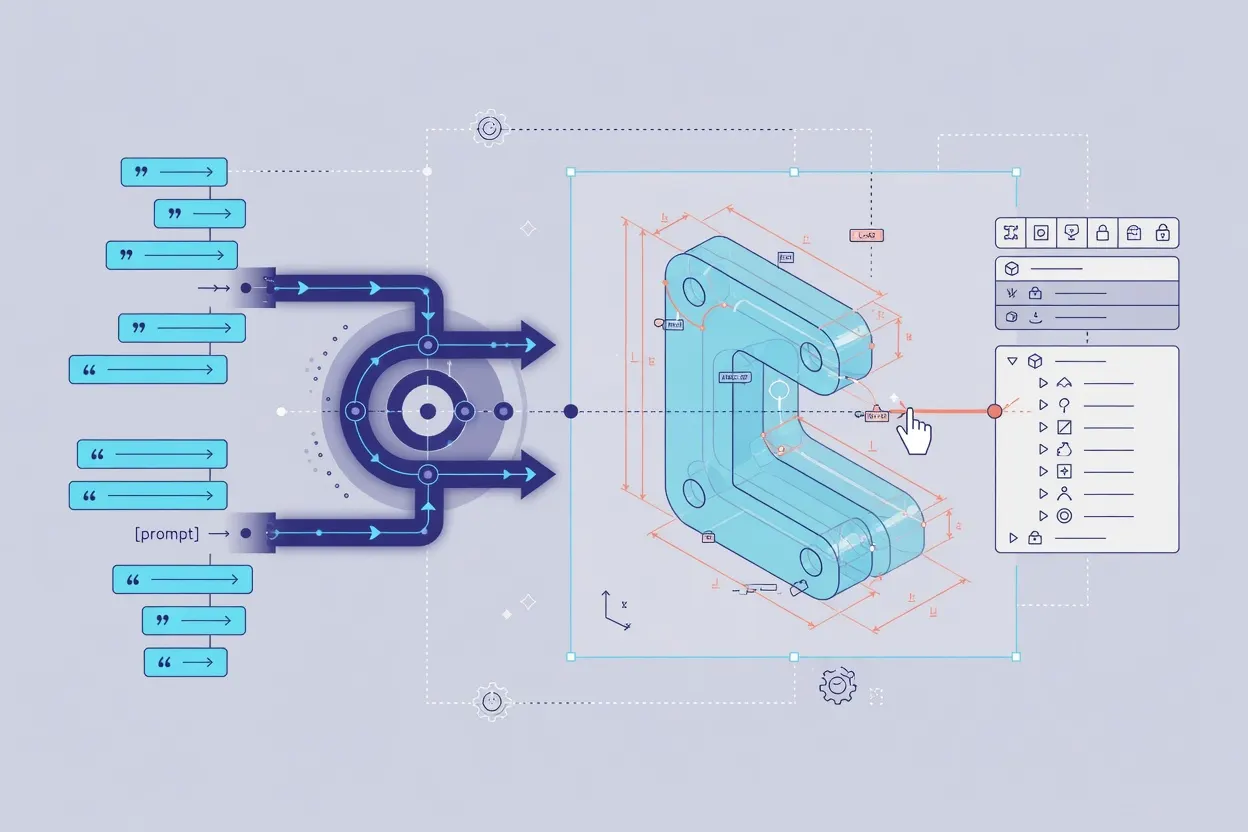
A research paper proposes a unified framework for generating CAD models from text prompts using large language models, claiming both user control and geometric accuracy.
The paper, posted to arXiv, frames controllability and faithfulness as a single unified problem rather than competing objectives. Earlier text-to-CAD systems tended to let you steer outputs or produce something geometrically plausible, but not reliably both at once. The work applies LLMs as the underlying engine, though the preprint does not describe production-scale validation beyond a lab setting.
CAD is a much less forgiving target than image generation. A wrong image is still an image, but a CAD file with bad geometry fails at manufacture, in simulation, and in downstream tooling. If the faithfulness claims hold up under independent replication, text-to-CAD could lower the barrier to early-stage product design in a market dominated by expensive, hard-to-learn software.
The real test will come when text-to-CAD startups or major CAD vendors attempt to reproduce these results outside a lab.