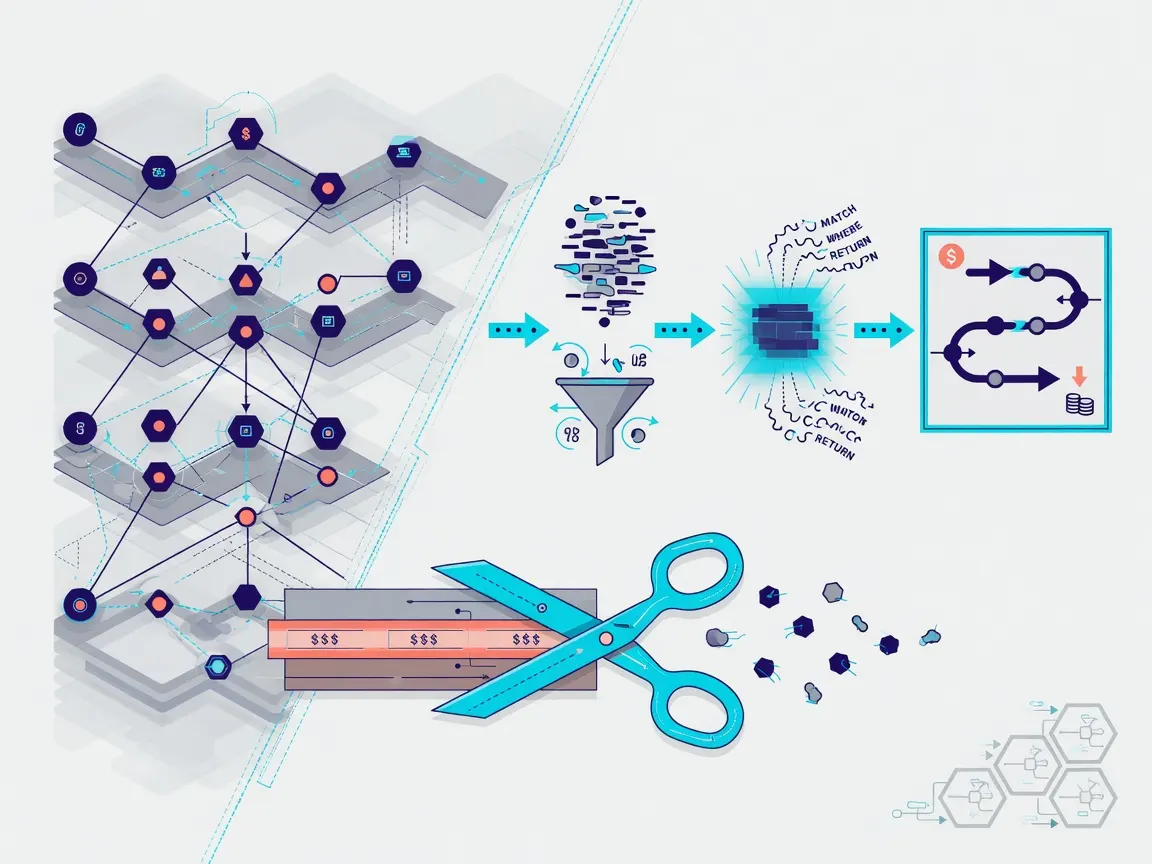
A research pipeline called KG2Cypher makes it cheaper to build natural-language interfaces on top of private enterprise knowledge graphs.
The system works by pulling facts directly from an existing graph to generate executable Cypher queries first, then using a large language model to write matching natural-language questions. Those pairs are filtered by an LLM judge and human reviewers, then used to fine-tune a query generator via LoRA — a technique that adapts a model to a new task without retraining it from scratch. The trained model is served with schema prompting and entity retrieval to keep it grounded in the graph's actual structure.
The results are hard to dismiss. On Korean enterprise data — where short, search-style queries make language grounding unusually tricky — LoRA fine-tuning pushed execution-result F1 from 0.806 to 0.950 on broadcast-program queries and from 0.70 to 0.92 on company queries. In an 11-class setting, the system hit 95.2% exact match and a 99.9% execution rate.
The wider point is that the hardest part of text-to-query systems has always been labeled training data — expensive to build, slow to validate, and tied to one schema. KG2Cypher's approach of bootstrapping pairs from the graph itself sidesteps that bottleneck, which is why it is worth watching even if the paper focuses on Korean enterprise use cases. Whether it generalizes cleanly to messier, less-structured Western enterprise graphs is the question the authors leave open.