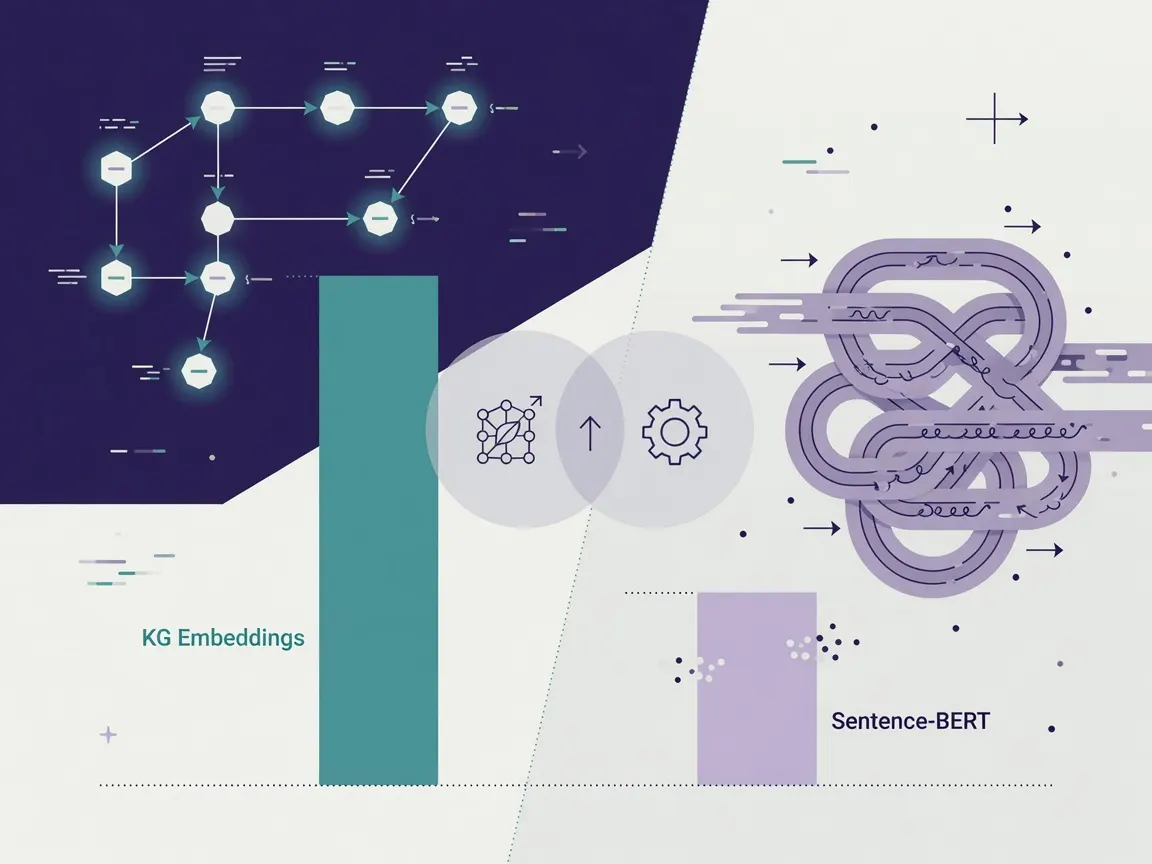
Knowledge graph embeddings outperformed a popular text model on a new semantic similarity task — and did it with less overhead.
Researchers built a dataset to test whether different methods can determine if two knowledge graphs represent the same underlying information. They extracted knowledge graphs from original and modified text documents, then used the known relationships between those documents as ground truth for graph pairs. Against that benchmark, they tested text-based, structure-based, and embedding-based approaches. Their embedding method, EmbPairSim, scored up to 5.3 percentage points higher on MRR than Sentence-BERT while using substantially fewer parameters.
Most knowledge graph embedding research stops at the entity and triple level — whether two facts are related — not the graph level, where you ask whether two entire knowledge graphs mean the same thing. Closing that gap matters for any system that needs to reconcile knowledge bases, detect duplicate information across sources, or merge graphs from different domains.
The result is a useful reminder that purpose-built representations can outperform general-purpose language models on narrow tasks — though the benchmark itself was constructed by the same team, which is worth keeping in mind when reading the margins.