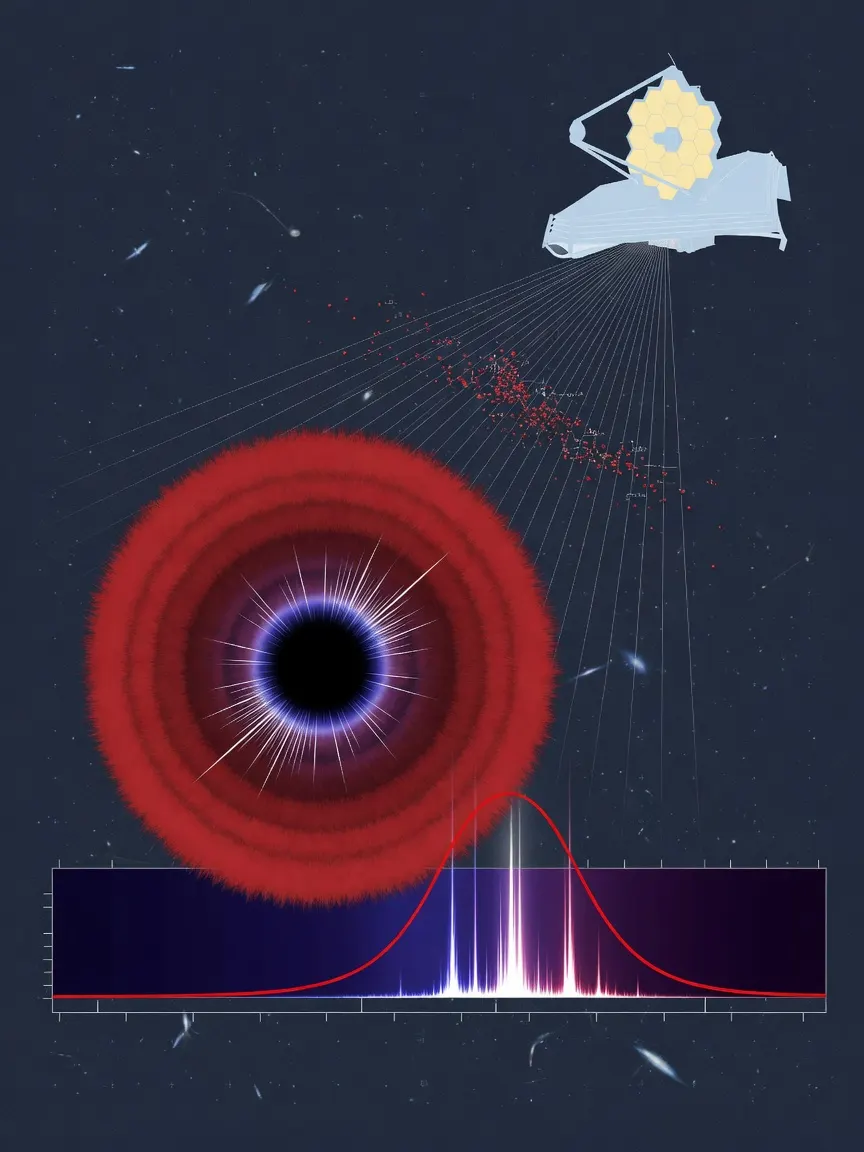
New spectral data from the James Webb Space Telescope points to a straightforward explanation for the "little red dots" that briefly looked like they might break cosmology.
A team led by Vasily Kokorev at the University of Texas at Austin analyzed GLIMPSE-17775, a compact red object that existed about 1.8 billion years after the Big Bang. By splitting its light into more than 40 distinct chemical signatures, they found that the light had bounced around inside a dense cocoon of gas before reaching us. That only happens when surrounding gas is far denser than anything astronomers see in an ordinary galaxy. At the center likely sits an actively feeding supermassive black hole, a configuration some researchers call a "black hole star." The team published their findings in The Astrophysical Journal.
The study carries a quieter implication that matters as much as the headline result: prior mass estimates for these objects were probably unreliable. Earlier measurements relied on tracking how fast gas moves around the black hole, but in an environment this dense, the light is already heavily distorted before it reaches any telescope. If these black holes are smaller than they appeared, the puzzle of how something so massive formed so early in cosmic history becomes far less urgent, and one of the main reasons astronomers thought these objects were exotic simply dissolves.
The "little red dots" were briefly candidates for breaking cosmology. They may turn out to be ordinary quasars wearing unusually heavy coats.