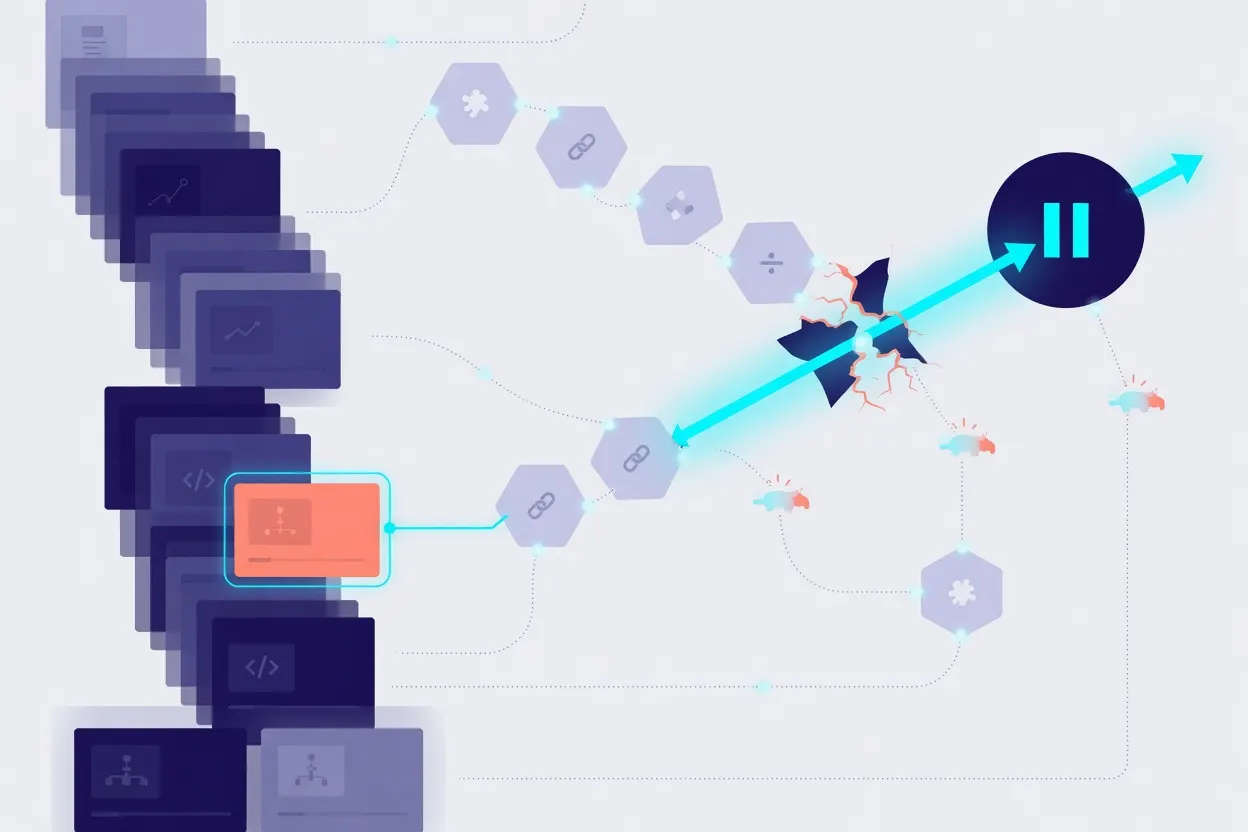
A research system called HippoSpark aims to fix a specific failure mode in AI reasoning: models that stall not because they lack general knowledge, but because they hit a local bottleneck with no precise guidance.
Most existing approaches to "experience replay" for large language models work at the task level — they summarize past problem-solving runs and hand that summary to the model when a similar task appears. The assumption is that analogous tasks share universal solution patterns. HippoSpark, introduced in a new paper, rejects that assumption. Instead of task-level summaries, it stores experience at the state level and retrieves it on demand, matched to exactly where in a reasoning chain the model currently sits. Tested across mathematical, scientific, and programming benchmarks, it outperformed both standard prompting and task-level experience baselines. Code is available on GitHub.
The distinction matters because it points to a structural limitation in how most retrieval-augmented reasoning systems are built. Broad heuristics are cheap to generate and easy to store, but they help least when a model is mid-chain and stuck on a precise sub-problem — which is often where complex reasoning actually breaks down. State-level retrieval is more expensive to build but more useful at the moment that counts.
This sits in a growing pile of research arguing that finer-grained memory and retrieval — not bigger context windows or stronger base models — may be the more tractable path to reliable multi-step reasoning. Whether the benchmark gains hold outside controlled settings is the question every paper in this line of work still owes an answer to.