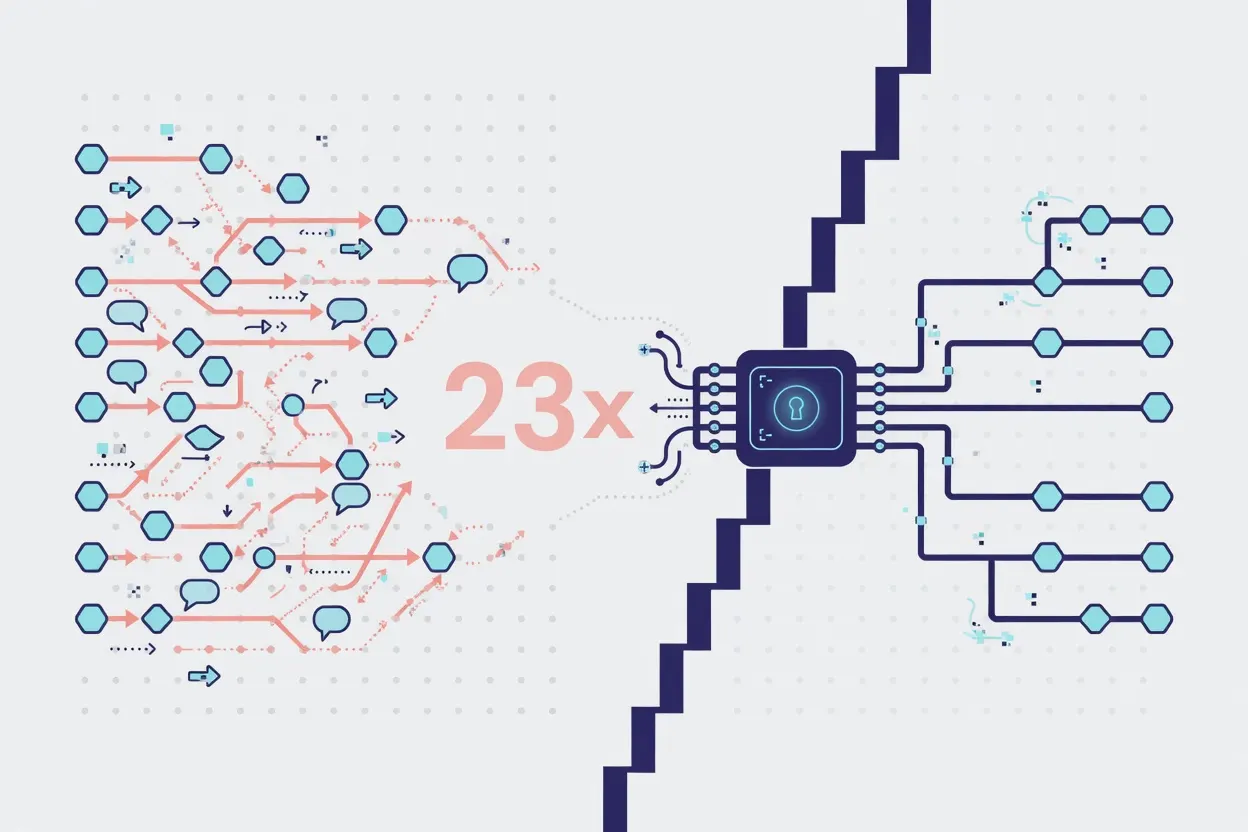
A research paper out of arXiv proposes a leaner way for AI agents to talk to each other during cooperative tasks.
Most multi-agent reinforcement learning systems let agents broadcast dense, unstructured vectors to one another — essentially sending everything and hoping the receiver figures it out. HiComm flips that model. Instead of the sender pushing a blob of data, the receiver issues a query, and a three-stage decoding process pulls exactly the relevant slice of information from the sender's structured observation hierarchy: first a group, then a specific agent, then a specific entity. The result is structured information retrieval rather than raw vector transmission. In experiments across cooperative tasks, HiComm matched or beat existing learned-communication baselines while cutting communication volume by up to 23 times per receiver per episode.
The efficiency gap matters because communication overhead is one of the quiet bottlenecks in scaling multi-agent systems. Trimming message volume by more than an order of magnitude without a performance penalty suggests the field has been leaving structure on the table — treating observations as flat when the environments they describe are inherently hierarchical. That inductive bias, once baked in, does real work.
HiComm is designed as a plug-in module compatible with standard pipelines, which lowers the barrier to adoption — though "plug-in" claims from academic papers have a habit of meeting real codebases and discovering friction.