A research team has built a GUI agent that learns to navigate interfaces mostly from raw, unlabeled screenshots — cutting the need for expensive human-annotated data by a factor of a thousand.
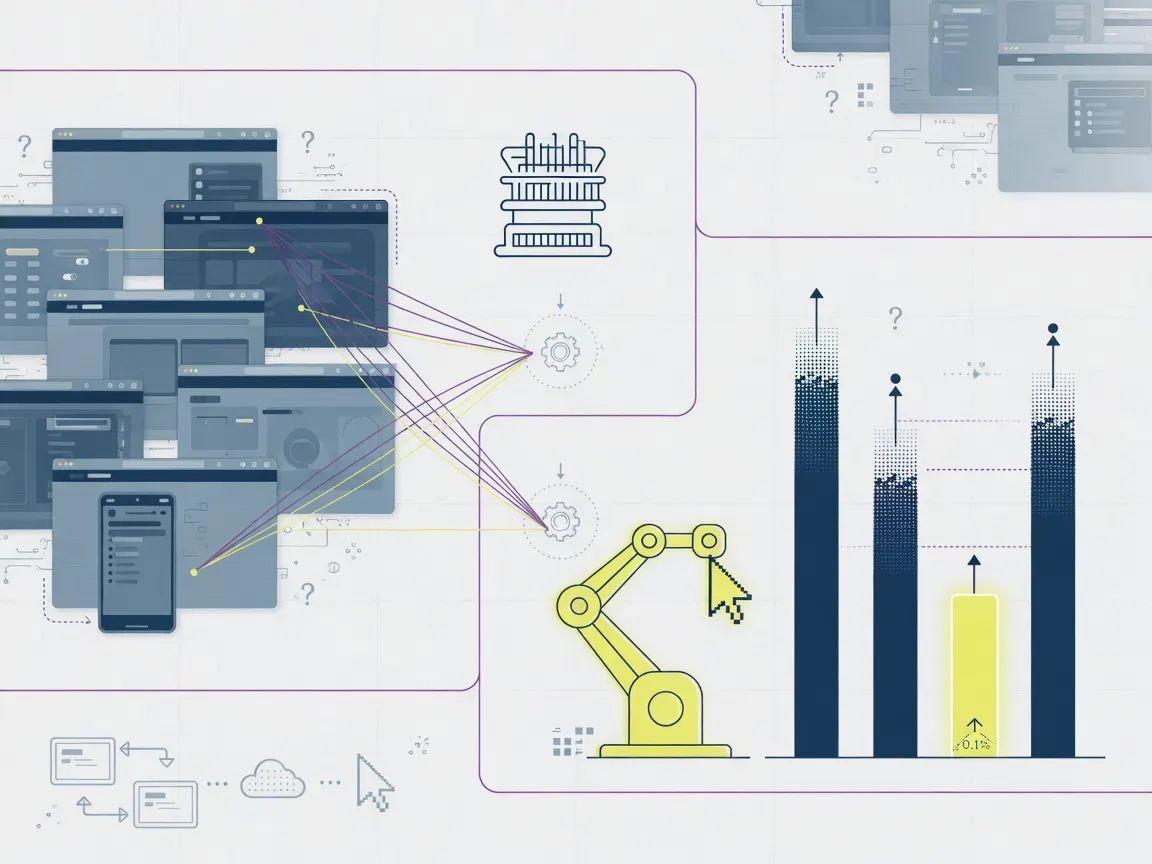
The system, called GUICrafter, uses a two-stage curriculum. In the first stage, the model develops visual grounding — the ability to locate and interpret specific on-screen elements — by processing large volumes of unannotated screenshots and webpages. The second stage applies reinforcement learning on a small set of high-quality labeled examples to sharpen accuracy. According to the paper, GUICrafter matches or beats UI-TARS, a leading GUI agent, while training on only 0.1% of the data UI-TARS requires. It also outperforms GUI-R1 when both are given identical amounts of annotated data.
This matters because labeled GUI data is one of the field's stubborn bottlenecks. Unlike text, which can be scraped cheaply from the web, GUI interaction data requires recording sessions, annotating actions, and verifying intent — work that does not scale easily. A method that extracts usable signal from raw screenshots could let researchers and companies build capable agents without the annotation pipeline.
The approach mirrors what weak supervision has already done for image classification and natural language tasks — trading annotation cost for clever training design. Whether GUICrafter's gains hold across the messy diversity of real-world interfaces, versus the benchmarks used here, is the question the paper does not fully answer. Code, data, and models are public on GitHub.