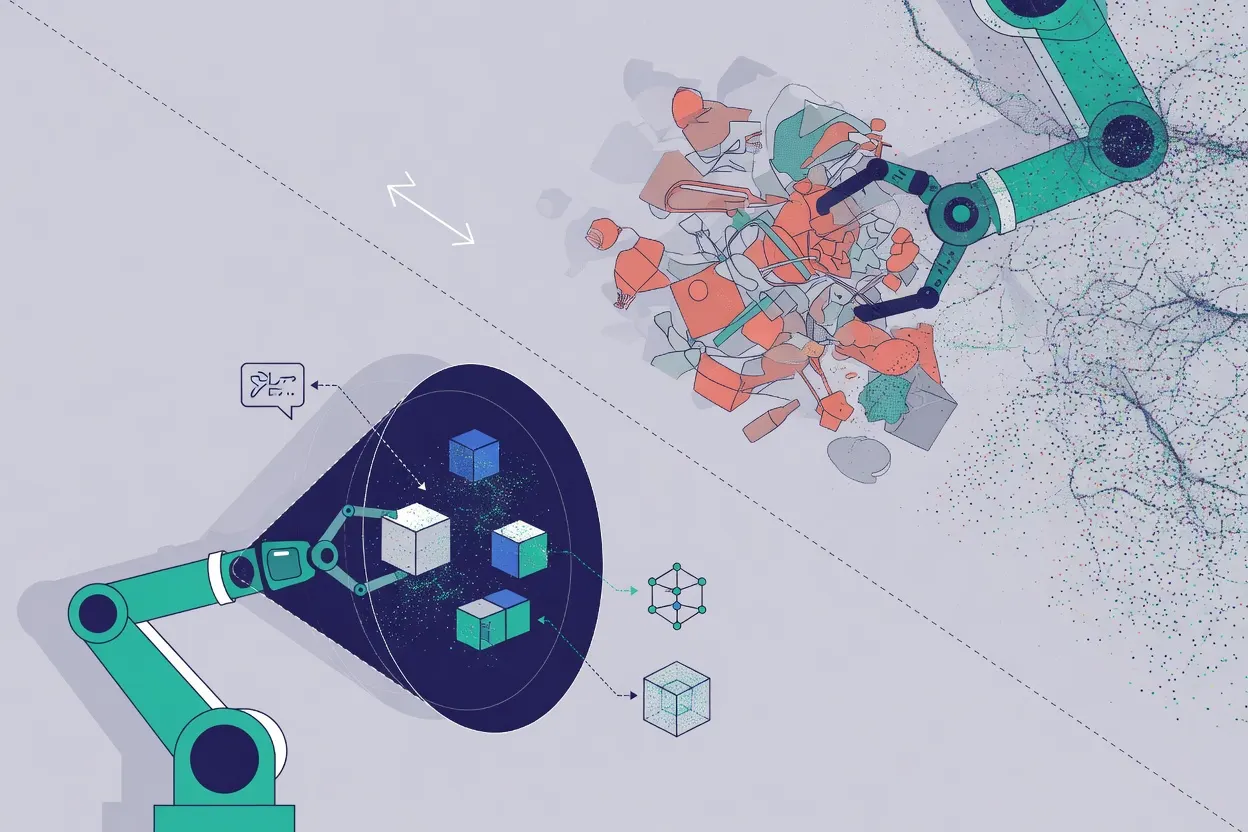
A new robotics AI framework called FOCAL-VLA teaches robot arms to stop wasting attention on background clutter and focus on whatever they're actually grabbing.
Researchers built FOCAL-VLA, a vision-language-action (VLA) model that turns camera images and text instructions into robot movements. Existing VLA models often fumble precise, multi-step manipulation because they don't build a real sense of 3D space or how a scene changes over time. Prior fixes tried predicting geometry and future scene states wholesale, but that buries the model in irrelevant detail. FOCAL-VLA narrows the focus instead, borrowing 3D geometry knowledge from a computer-vision model called VGGT for only the image regions tied to the current subtask, while separately predicting how the interaction will unfold using a technique called Track4World - all without running either extra model once the robot is actually working.
That's a narrow but concrete fix to a real weakness in robot foundation models: they often see the whole room but understand little about what's geometrically relevant to the job at hand. The researchers report FOCAL-VLA beating baseline VLA models on both simulation benchmarks and real-world manipulation tasks.
It's an arXiv preprint with a project page and no independent replication yet, so treat the gains as promising, not proven - and one more sign robotics research is leaning on borrowed pretrained vision models instead of building geometry understanding from scratch.