Flow models can now catch their own mistakes - and that changes how much compute reasoning actually costs.
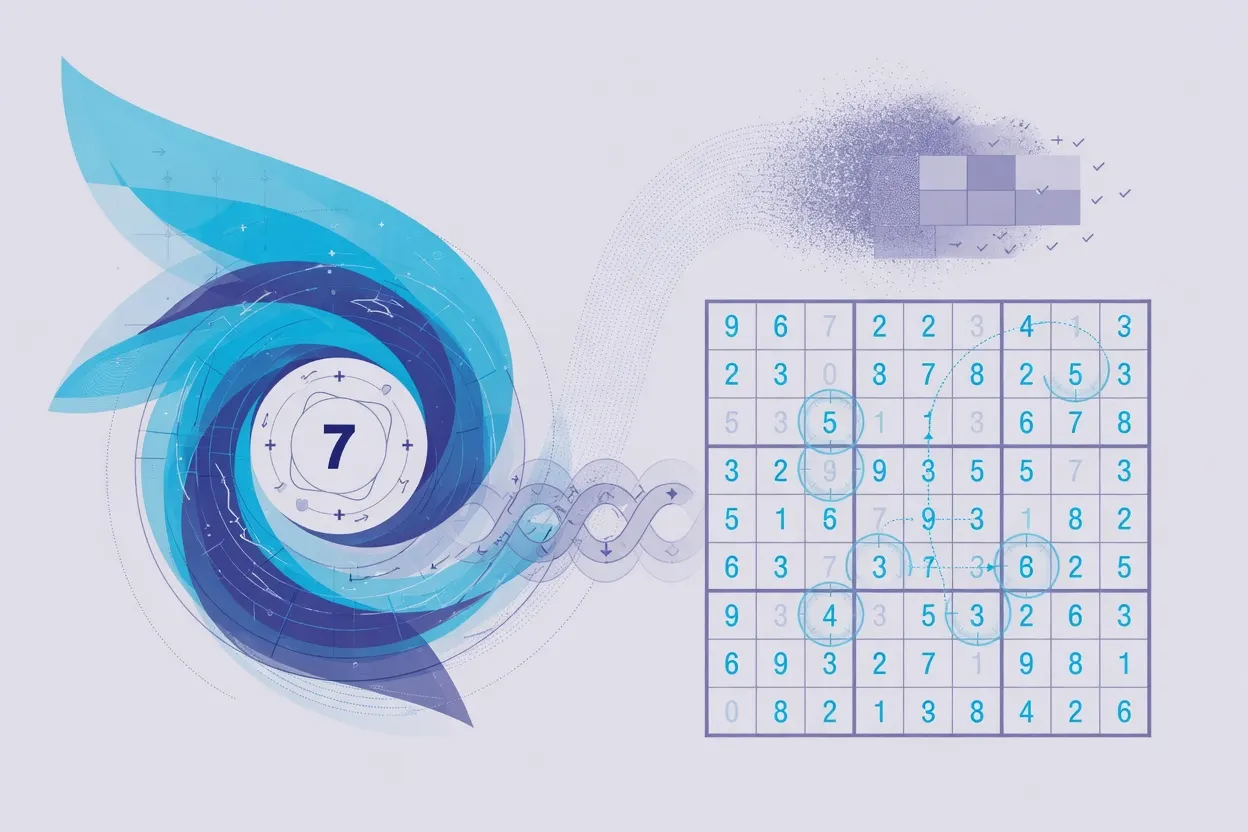
Researchers introduced Flow Reasoning Models (FRMs), a framework that addresses a specific failure mode: standard discrete flow models, when applied to logic puzzles like Sudoku or Zebra problems, converge confidently on wrong answers, solving only about 36% of Sudoku puzzles out of the box. The key insight is that a correct answer is a stable fixed point - re-noise it, re-solve it, and it returns to itself. Wrong answers do not. That property lets the model act as its own verifier without any external judge. Combining that self-verification with two training changes - a self-conditioning channel that lets models refine past predictions, plus direct preference optimization to steer away from failed generations - pushes solve rates to 99.2% on Sudoku in just seven forward passes.
That efficiency gap matters. The strongest masked-diffusion baseline the researchers compared against needs more than eight times as many forward passes to hit the same accuracy. And the approach generalizes: FRMs trained only on standard Sudoku solved harder out-of-distribution Sudoku-Extreme puzzles at 96.1%, without ever seeing that distribution during training.
The wider implication is that test-time scaling does not have to mean brute-force sampling at enormous cost. If models can self-filter using their own dynamics, the compute bill for reliable structured reasoning drops considerably. The obvious caveat: Sudoku and Zebra puzzles have ground-truth verifiability baked in. Whether the same self-stability trick holds for messier, open-ended tasks is the question this paper leaves open.