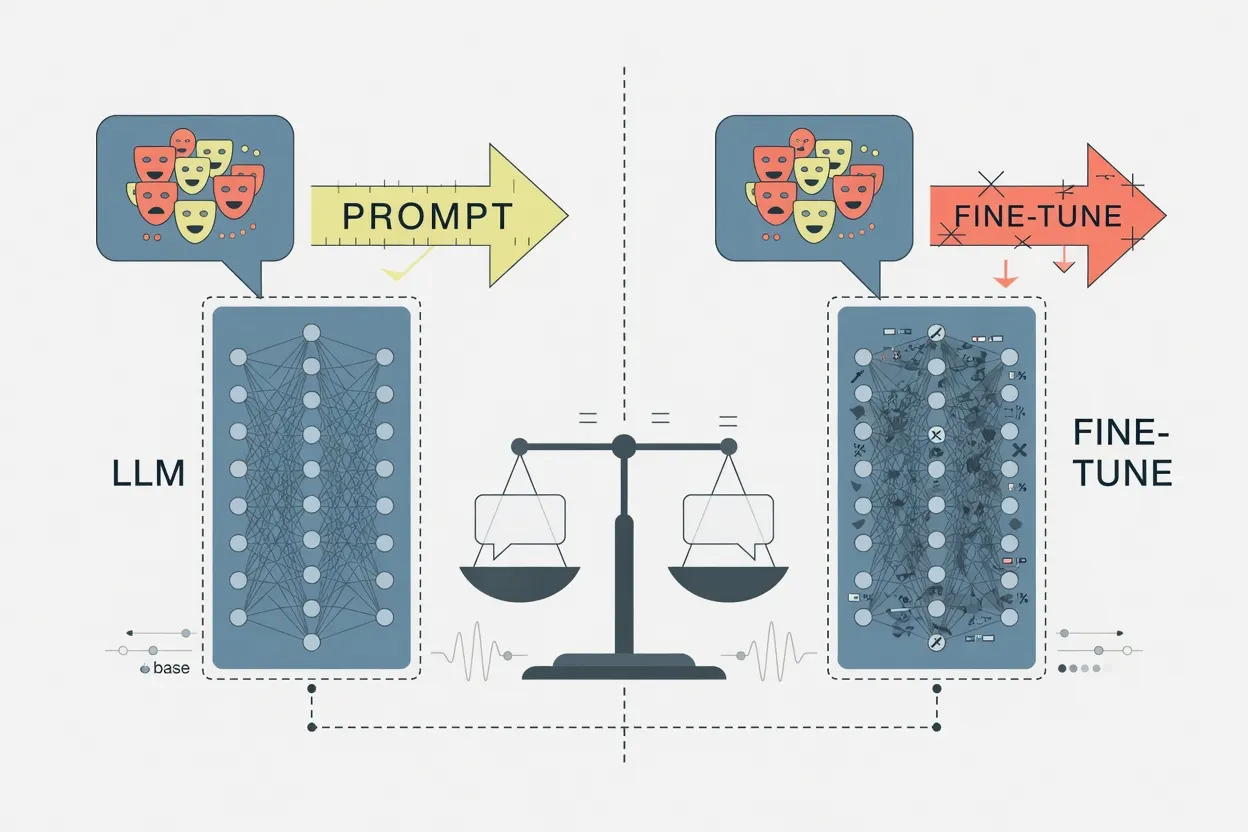
Turns out you don't need to retrain a chatbot to give it a personality.
Researchers fine-tuned two open-weight LLMs, Qwen2.5-7B-Instruct and Ministral-8B-Instruct, on a corpus mixing personality-labeled social media posts with dialogue data, aiming to build a personality-driven dialogue engine for social simulations and robots. They tested the fine-tuned versions against their untouched baseline models across multiple social interaction scenarios, using three separate LLM judges to score personality fidelity and explain their reasoning. Fine-tuning made the Qwen model's language more varied, but neither model got measurably better at consistently playing a given personality. The judges also disagreed with each other often enough that the researchers flag low confidence in the results.
For anyone building social robots or simulated characters, this is a useful reality check: expensive fine-tuning didn't beat plain instruction prompting at the one thing it was supposed to improve. The bottleneck looks less like model architecture and more like training data - the researchers point to data quality and domain alignment as the next fix, not more tuning.
Before fine-tuning a model to have a personality, it might be worth checking whether you are just teaching it to sound like a well-labeled social media corpus.