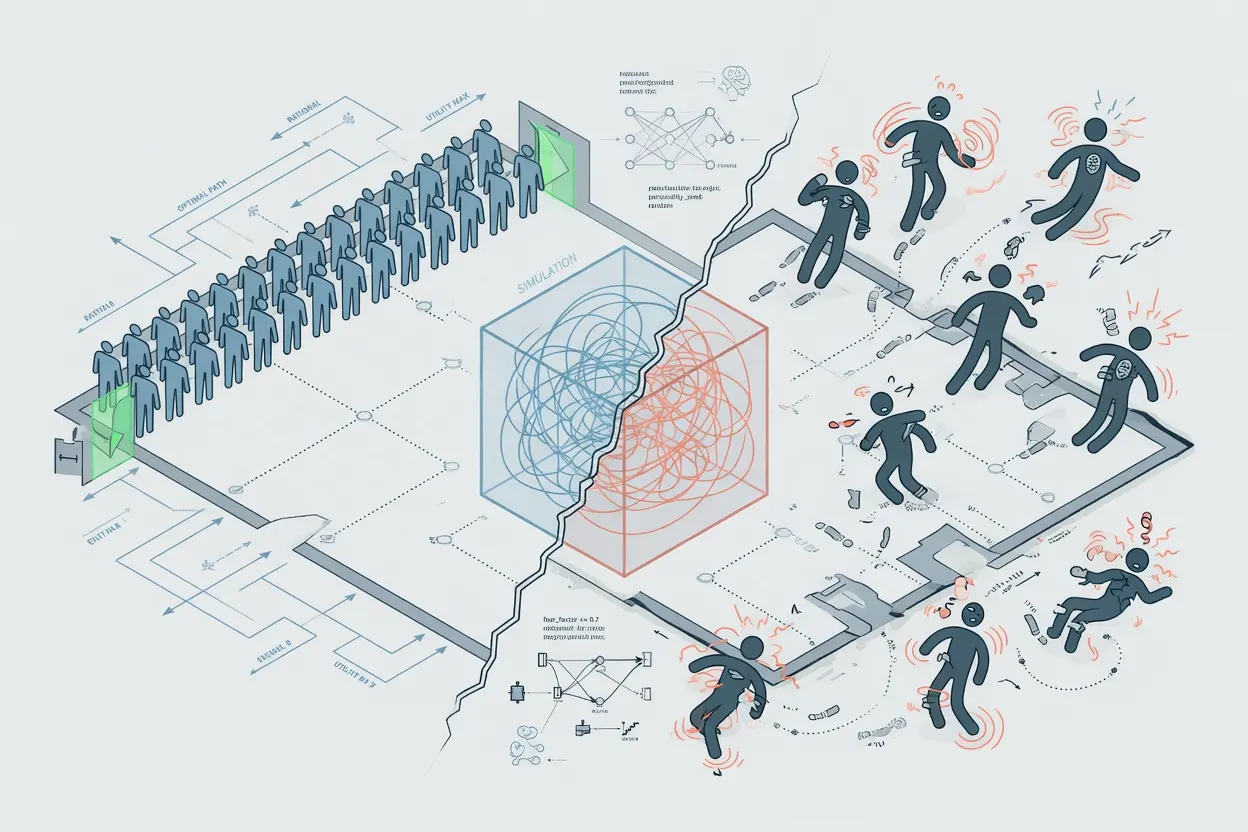
Most evacuation software assumes people know where the exits are and act sensibly under pressure. A new academic framework argues that is precisely wrong.
Researchers have published a simulation framework that layers cognition, emotion, and personality onto standard agent-based evacuation models. Instead of omniscient, rational actors, the agents in this system forget exit locations, experience escalating fear, and are shaped by personality traits drawn from the OCEAN model — a well-established psychological framework covering openness, conscientiousness, extraversion, agreeableness, and neuroticism. Neuroticism in particular wires directly into how quickly an agent panics, how contagiously that panic spreads to neighbors, and how slowly it fades. A continuous "Event Certainty Level" governs how much each agent actually knows about what is happening around them at any given moment.
The gap this fills is real: crowd simulations inform building codes, stadium layouts, and emergency response planning, yet most models treat the human element as a solved problem. A framework that generates realistic delays, confusion clusters, and socially transmitted panic gives planners something closer to what actual disasters produce.
The caveat is that adding psychological realism to a model also adds parameters — and parameters need calibration against real evacuation data, which is both rare and ethically difficult to gather. Whether the added complexity translates into meaningfully better predictions, or just more convincing-looking chaos, is a question the researchers acknowledge but have not yet answered at scale.