AI navigation agents have a getting-lost problem, and researchers think they've found two specific reasons why.
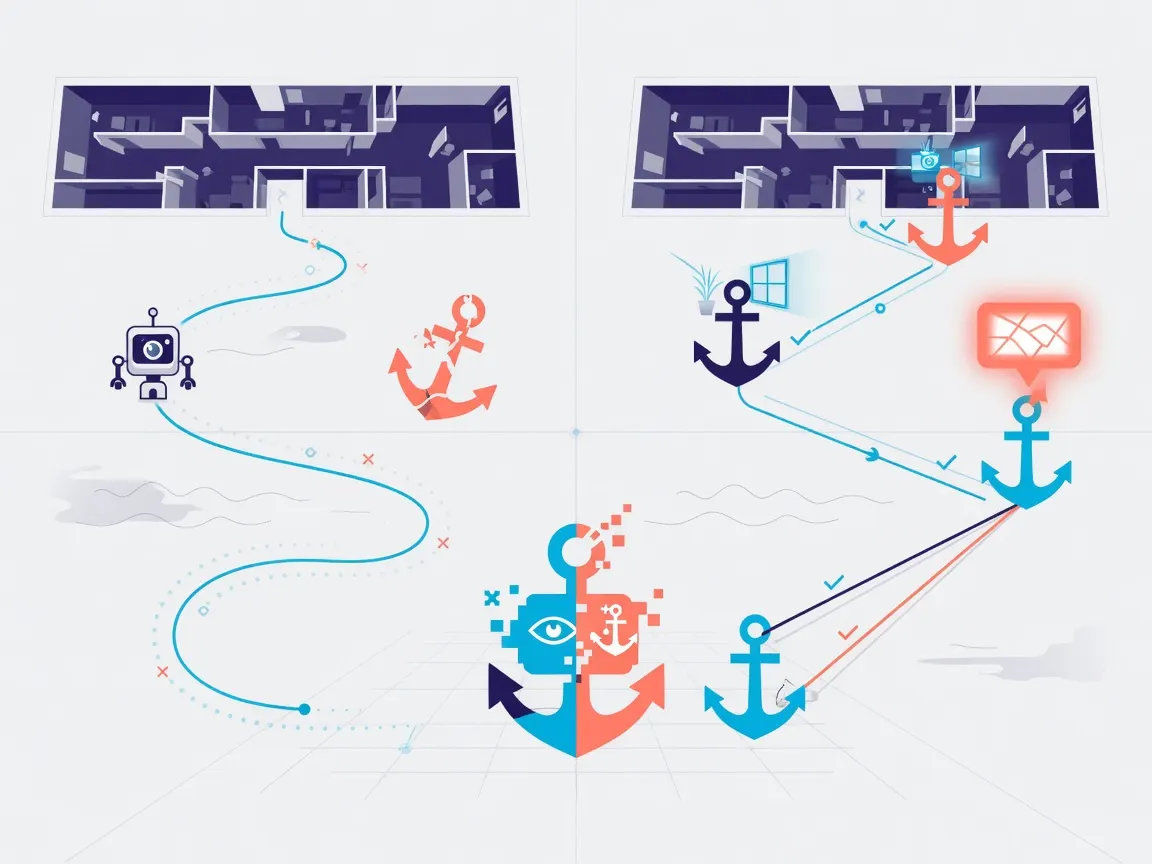
A team working on vision-language navigation — where an AI agent moves through a 3D space by following plain-language instructions — identified a pair of failure modes they call Progress Drift and Memory Drift. Progress Drift is when the agent loses track of which sub-goals it has already completed. Memory Drift is when its record of visited landmarks degrades until it effectively forgets where it has been. Their proposed fix, a Dual-Anchoring Framework, addresses each failure separately: one component supervises the agent to generate structured tokens marking completed versus remaining steps; the other uses a landmark-centric world model to retroactively verify past observations against object-level embeddings extracted by Meta's Segment Anything Model. The researchers trained the system on datasets they curated themselves — 3.6 million samples with explicit progress descriptions and 937,000 grounded landmark examples.
The results matter because long-horizon navigation is where most prior systems quietly fall apart. A 15.2% improvement in overall success rate is meaningful, but the 24.7% gain specifically on long-horizon trajectories is the number that signals a real structural fix rather than incremental tuning. As AI agents are increasingly deployed in embodied and real-world contexts — warehouse robots, autonomous inspection drones, assistive devices — the gap between short-corridor demos and extended real-world runs is exactly the gap the field needs to close.
The team says code, data generation pipelines, and datasets will be released publicly, which is the right call; claims about world models and retrospective landmark verification are the kind that benefit from independent replication before anyone builds a product on top of them.