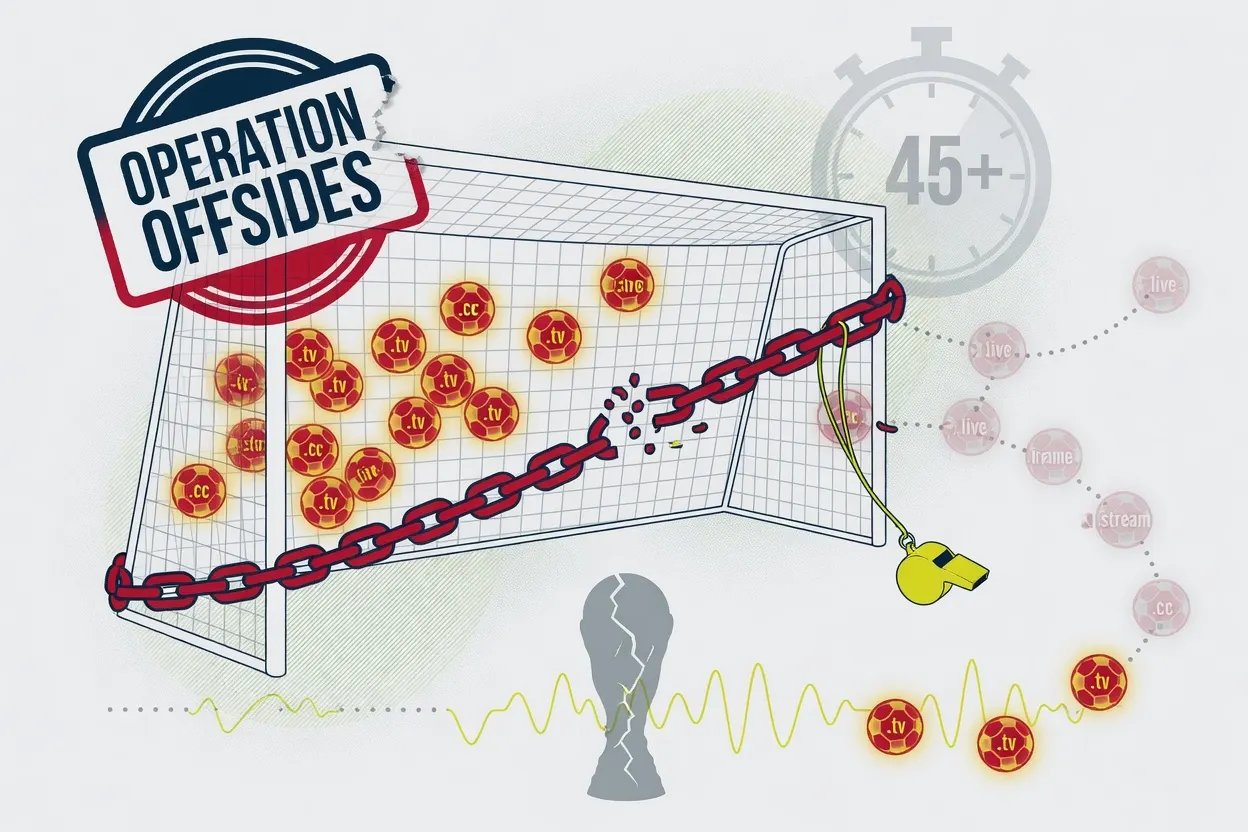
The Department of Justice shut down nearly 400 streaming domains during a live World Cup — a scale of enforcement that is unusual even for major sporting events.
On June 26, the DOJ announced the seizures as part of "Operation Offsides," an international effort coordinated through the National Intellectual Property Rights Coordination Center alongside Homeland Security Investigations, FIFA, NBCUniversal, Warner Bros., and the UFC. Anyone who clicked a seized domain found a law enforcement notice instead of a stream. Actions extended beyond U.S. borders: servers and domains were targeted in Peru and Bulgaria, with additional disruption efforts in Croatia, Romania, Poland, and Colombia.
The timing matters. Just days before the DOJ announcement, a separate coalition — ACE, UEFA, and Mexican authorities — disrupted 44 domains tied to PirloTV, a major illegal sports streaming network that drew more than 950 million visits per year globally. New domains reappeared almost immediately. The back-to-back actions expose the core tension: enforcement is reactive by design, while piracy infrastructure is cheap to rebuild. Officials added a consumer-safety argument to the copyright case, noting that a 2022 FACT report found malicious content on all 50 illegal sports streaming sites it examined, including banking trojans and scam ads.
The underlying demand is not going away. Broadcast rights for a tournament this size are split across cable packages, streaming apps, and regional deals — making legal access genuinely confusing and expensive for many fans. Seizing 400 domains mid-tournament is a serious operation, but it is more speed bump than solution.