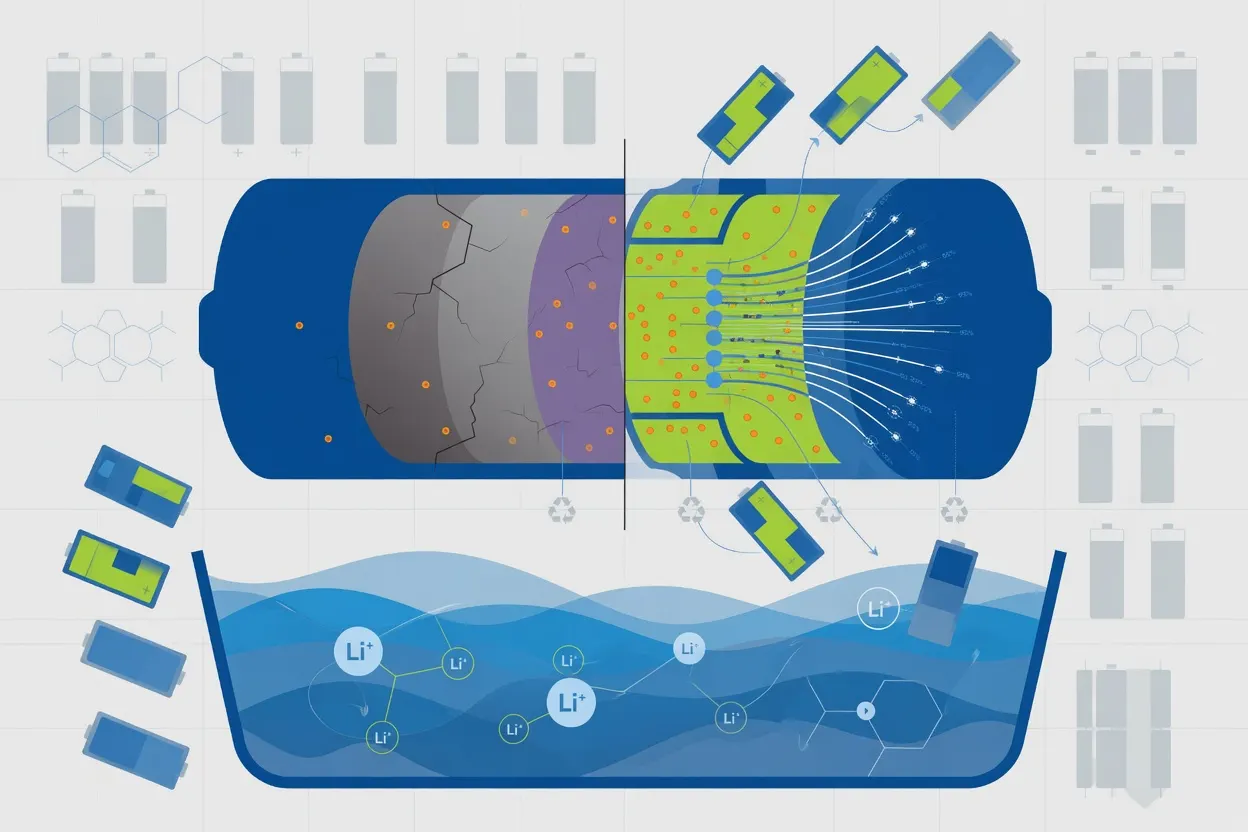
Cornell researchers say a chemical treatment can bring a worn-out EV battery back to near-original capacity — and make recycling cheaper in the same step.
A team at Cornell University developed a process that soaks degraded lithium-ion battery cathodes in a chemical solution, repairing the crystal structure that breaks down over repeated charge cycles. In lab tests, treated cells recovered up to 95% of their original capacity. The process also cut recycling costs by 56% compared to conventional methods, which typically shred and smelt batteries to extract raw lithium, cobalt, and nickel — destroying the cell to recover the ingredients.
That distinction matters more than the headline number. The dominant recycling model is inherently destructive: you dismantle to reclaim, then pay again to refine and rebuild. A repair-first approach, if it scales, could extend useful battery life before recycling is necessary at all — relieving pressure on the mineral supply chain and addressing one of the quieter friction points in the used-EV market, where degraded capacity is a persistent drag on resale value. Unlike swappable battery schemes that require hardware standardization, a chemical treatment could work on cells already in the field.
The research is still in the lab, and the distance between a compelling chemical process and a cost-effective industrial operation has swallowed more than a few promising ideas.