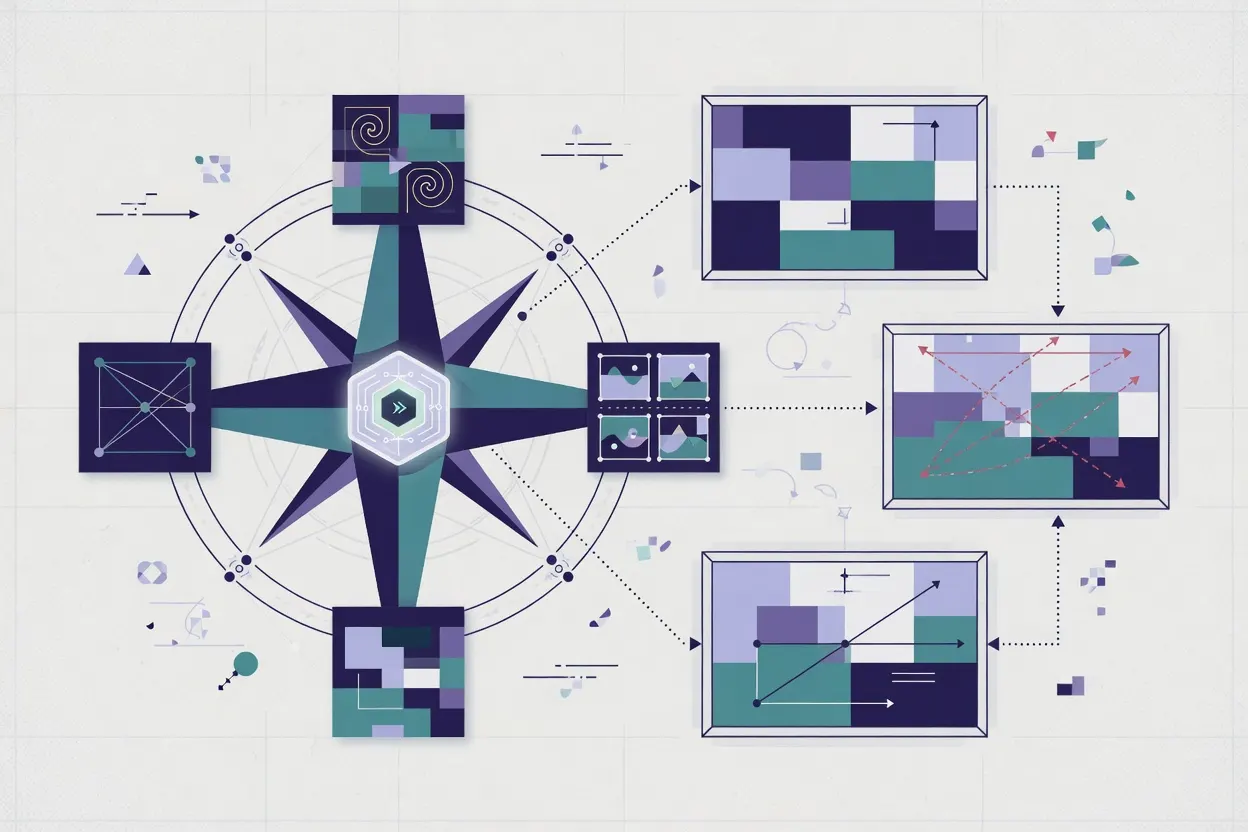
COMPASS is a new multimodal AI framework that can both recognize and control image composition — and it uses the same internal signal for both tasks.
Researchers built COMPASS around what they call composition intent: where subjects sit in a scene and how the overall layout is organized. The system injects composition expertise into a mixture-of-experts backbone, distilling that understanding into a shared expert token. On the generation side, that same token steers the diffusion process — so the model doesn't just analyze a desired composition, it actually produces one. To support training and benchmarking at scale, the team also built Comp-11, a dataset with 11 composition categories and reasoning-augmented annotations.
Most multimodal systems treat perception and generation as separate problems, which creates a gap: ask a model to describe an image's composition and it performs reasonably well; ask it to generate something with that same layout and you often get something entirely different. Routing both tasks through the same token is an architectural choice with real consequences, not a cosmetic one.
Of course, "substantially improves" is doing a lot of work in a paper abstract — the real test is whether COMPASS holds up when users push beyond its tidy 11-class taxonomy.