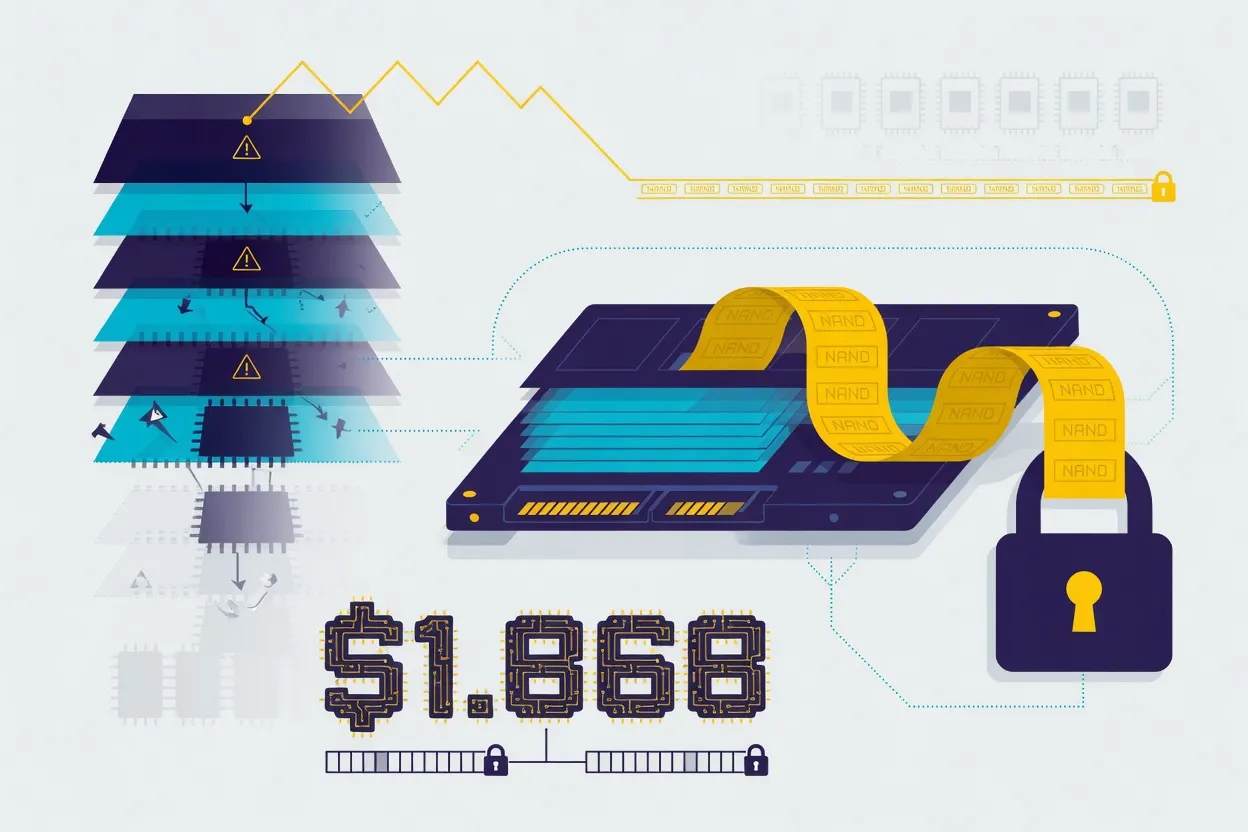
An SSD manufacturer has committed nearly $2 billion to secure its NAND supply for the next two years - a number that says more about the state of the memory market than any analyst note.
Biwin, which makes DRAM kits and SSDs but does not fabricate its own NAND flash, signed a two-year agreement with an unnamed supplier for $1.86 billion in chips, with deliveries beginning June 30, 2026. Both price and volume are fixed, so Biwin is insulated from spot-price spikes - but equally exposed if the market softens. That $1.86 billion figure exceeds half of Biwin's annual revenue, which means this is not a hedging move. It is a directional bet.
The bet reflects a consensus forming across the industry: the memory shortage is not a short-term blip. AMD's client channel chief told us recently that meaningful supply relief is unlikely before late 2027 or into 2028, as the three dominant NAND and DRAM producers - Micron, Samsung, and SK hynix - ramp capacity carefully. Samsung and SK hynix are deliberately pacing themselves, wary of overbuilding if AI-driven demand cools faster than expected. That caution, rational from each company's perspective, keeps supply constrained for everyone downstream.
For Biwin, the fixed-price structure is a double-edged hedge: smart if prices hold or rise, costly if the AI spending wave crests sooner than the two-year window closes. Either way, locking in supply at this scale is a statement that waiting for spot prices to fall is not a strategy Biwin can afford.