The $750 running watch lost to the $450 one, because it had never heard of the race.
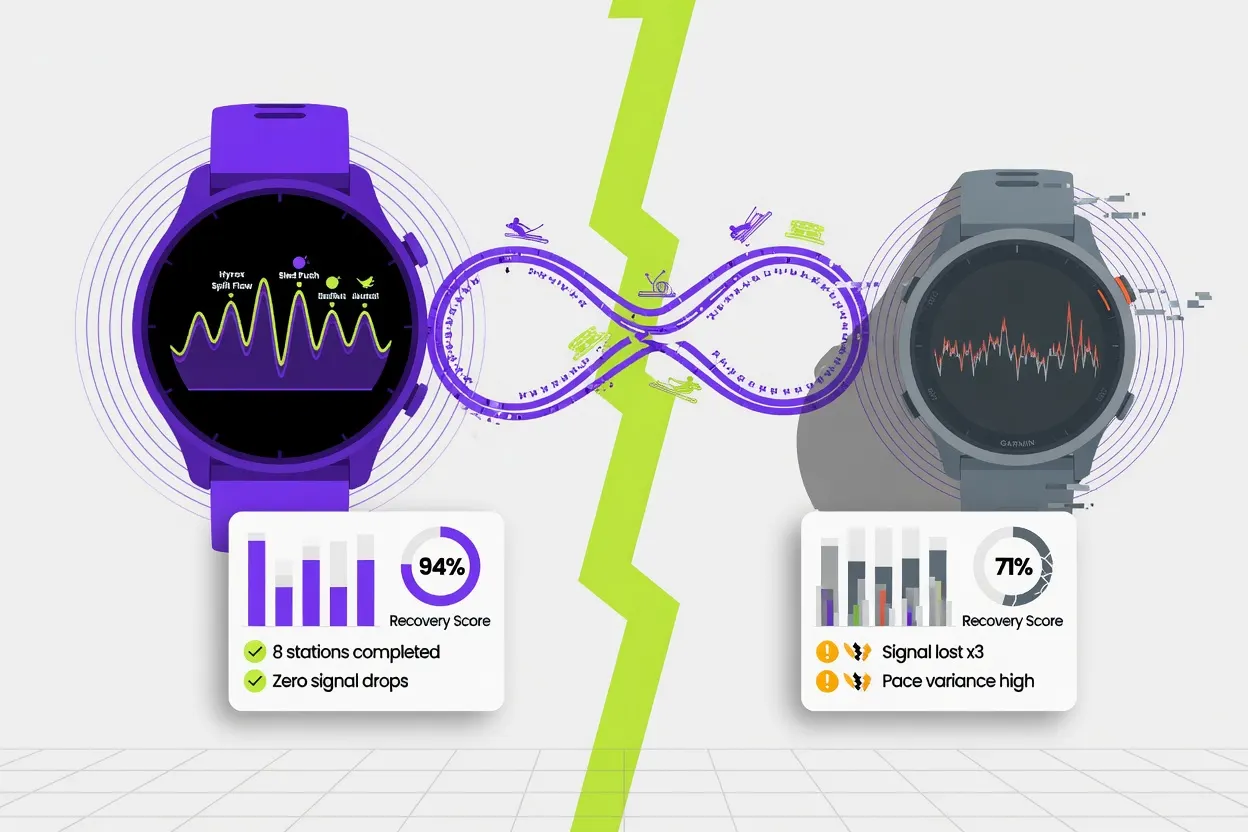
A side-by-side test during a Hyrox race strapped a Garmin Forerunner 970 and an Amazfit Cheetah 2 Pro to opposite wrists for a direct comparison. Hyrox alternates eight 1 km runs with functional exercise stations: sled pushes, rowing, burpee broad jumps, and wall balls. That specific structure exposed a gap in the Garmin. The Amazfit Cheetah 2 Pro has a built-in Hyrox mode baked into the workout menu; it knows the race format, flags upcoming stations with on-screen icons, and makes lap transitions feel natural. The Garmin Forerunner 970 has no native equivalent, requiring a third-party app called Roxfit to be installed and configured in advance. A missed setup step meant the watch logged every segment as a running interval, leaving post-race analysis as manual timestamp archaeology against a heart rate graph. The Amazfit's Zepp app, by contrast, generated a clean timeline organized around the race structure automatically.
Garmin's dominance in the running watch market is well-earned, built on deep running dynamics and a long head start on supported activities. But Hyrox is structured enough to punish a one-size-fits-all platform, and the Amazfit's $300 price advantage now has a feature argument behind it. As hybrid race formats grow, "best running watch" may need a narrower definition.
One honest caveat: optical wrist-based heart rate sensors tend to drift when wrist position changes, exactly what happens during sled pushes and rowing, so a chest strap would tighten the data comparison. The Garmin still leads for traditional running. For Hyrox race day, the cheaper watch did more homework.