Firms deploying AI still need humans who can pick up the slack when systems break — and a new working paper argues that how they train those humans depends heavily on whether workers can walk out the door.
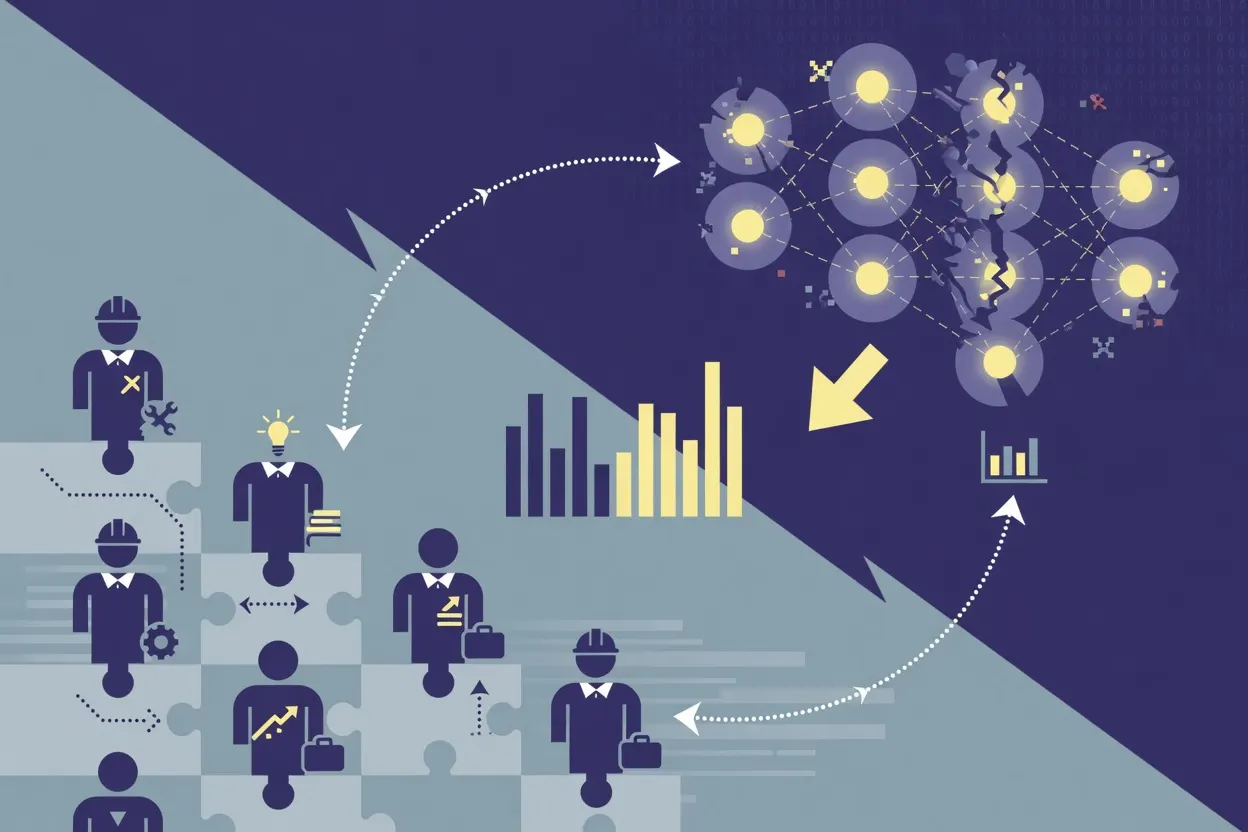
Researchers modeled a two-period scenario in which a firm uses AI that can outperform human workers but fails with some positive probability. The firm controls how much employees actually do versus how much the system handles — a choice the paper calls "engagement." Engagement costs output now but shapes worker skill later, either through learning or erosion. The model separates AI progress into two components: capability (output quality when the system works) and reliability (how often it works). In a closed labor market, firms put the most engagement into their least-skilled workers, because those workers have the biggest gaps to close and are cheapest to bring up to a useful fallback level.
Worker mobility flips that logic. When employees can leave for competitors, firms start treating human-skill investment as a recruiting tool — and higher-skill workers near the AI performance threshold become the more attractive target, because skill gains there are more valuable and engagement costs less. The result is that mobility can shift training investment away from the bottom of the skill distribution toward the middle-to-top, leaving the least-skilled workers with less development, not more.
The finding lands at an awkward moment for workforce policy. Corporate AI adoption is routinely defended with promises of upskilling and retraining for vulnerable workers — but this model suggests those promises are most credible only when workers have nowhere else to go. In competitive labor markets, the economic incentive points in the opposite direction.