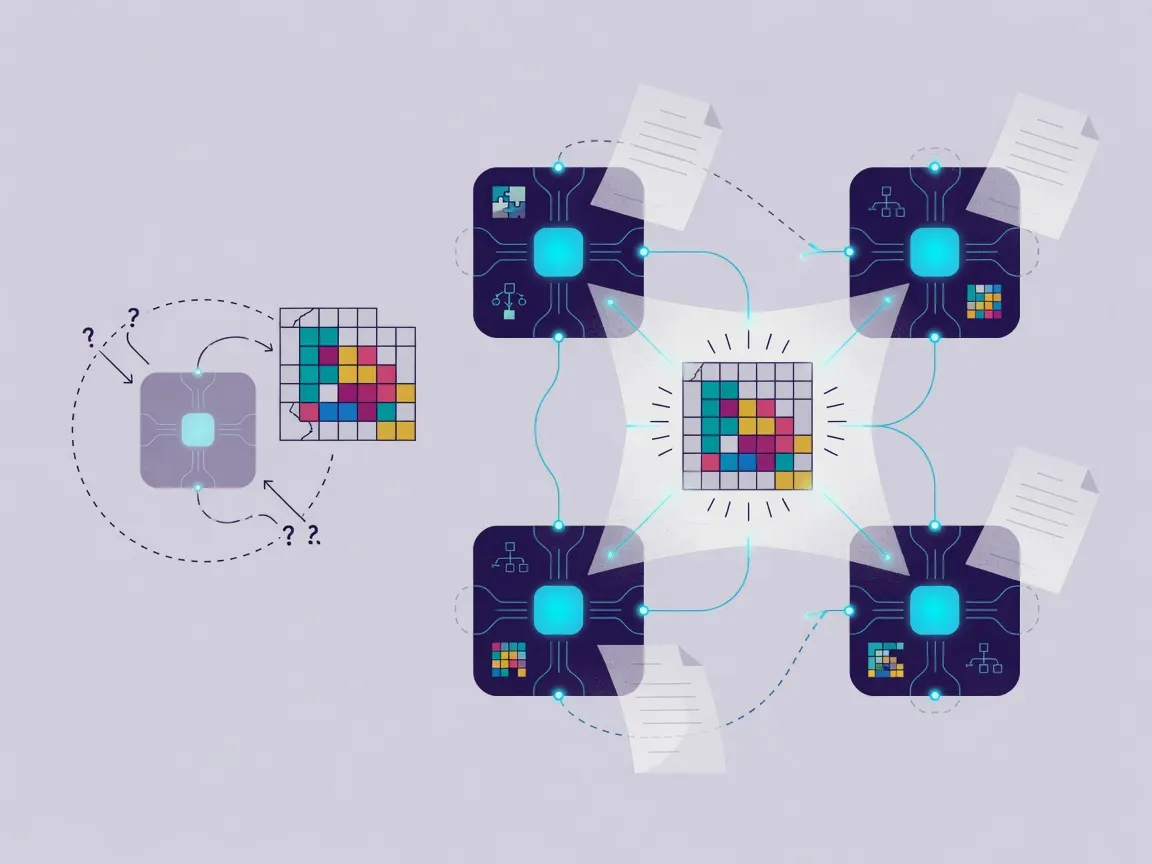
AI agents that trade notes mid-task can crack problems that leave solitary agents stuck.
Researchers tested groups of AI agents that communicate through a shared directory while working, with no assigned roles, on ARC-AGI-3, a benchmark built around novel problem-solving. A team of k communicating agents matched the success rate of 4k agents working independently, and the advantage grew as teams got bigger. The effect wasn't just about efficiency: some tasks that no single agent solved on its own were solved reliably once agents could share a breakthrough with the group. The same pattern held on research-style tasks given enough compute. On polyomino packing, communicating teams beat the best-of-k approach and topped the previous best-known score, and on MNIST classifier compression, a four-agent team produced a 1,957-byte classifier hitting 99.4% test accuracy, smaller than the best human-written solution and the best single-agent attempt.
The finding matters because multi-agent AI systems have had a spotty track record: prior work on whether agents actually benefit from talking to each other has been mixed, and a lot of the multi-agent hype in AI tooling has been more architecture diagram than proven advantage. This result gives a concrete case where coordination pays off, and it pays off more as you add agents, which is the opposite of the diminishing returns you'd expect from just running more parallel attempts.
The catch: communication only wins with sufficient compute and a clear signal of progress; without those, independent agents did just as well or better, so no, this doesn't mean bolt-on chatter makes any agent swarm smarter.