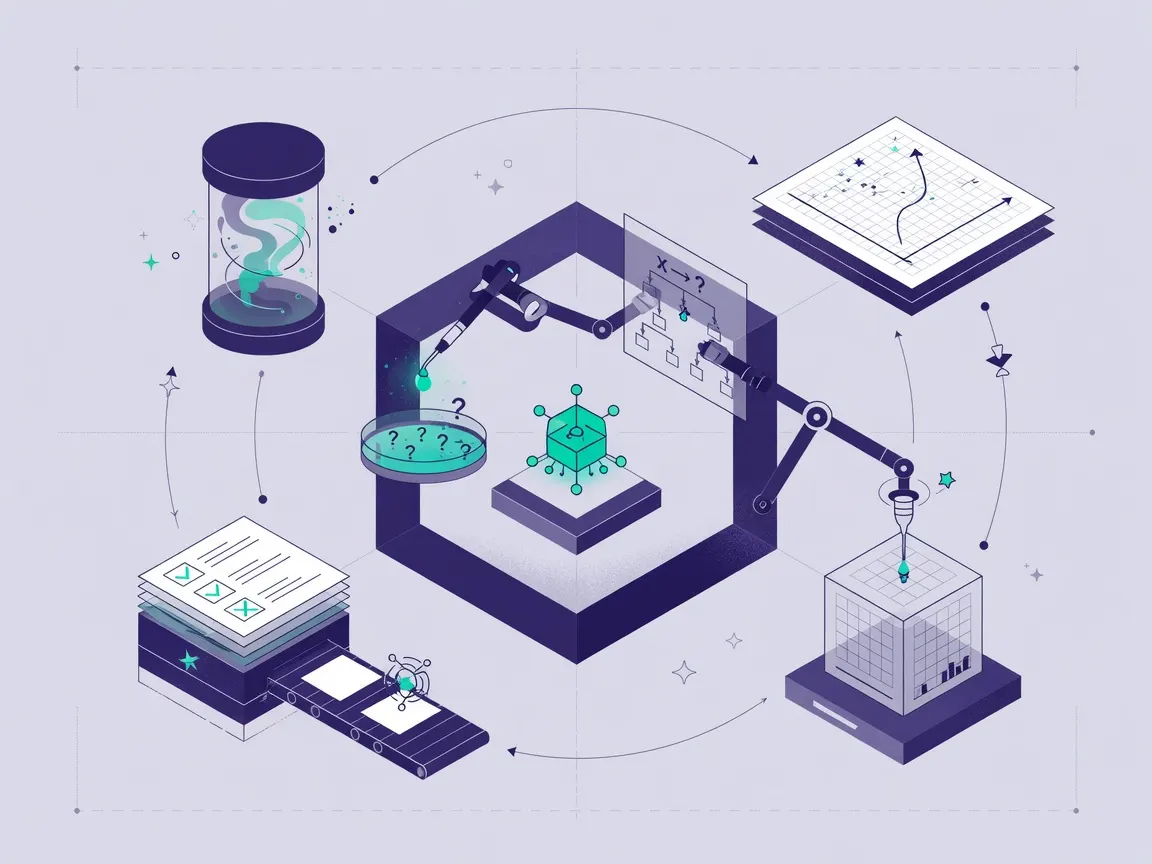
An AI research framework teaches language models to learn by doing, not just by recalling.
Researchers introduced Hierarchical Experimentalist Agents (HExA), a system that lets large language models actively design and run experiments rather than rely on fixed training data or retrieval. HExA iteratively proposes experiments, refines them based on results, and builds a reusable library of skills from what it learns. It requires no additional training, works with any existing model, and needs no external supervision or offline datasets. The team also released Interphyre, a benchmark built on a 2D physics simulator, to test how well agents can form and test hypotheses through simulation.
The performance gap is hard to ignore. Claude Sonnet 4.6 on its own solved 2% of Interphyre's hardest tasks; the same model running inside HExA hit 77%. That is not a marginal gain — it signals that the ceiling on today's agents may have less to do with model capability than with how they are allowed to interact with their environment. Skills learned on easier tasks also transferred to harder ones without additional experimentation, reaching 44% success.
Most agent research still treats knowledge as something to retrieve, not something to discover. HExA is a bet that the latter approach scales further — though benchmarks built around 2D physics simulations have a long history of looking more impressive in the lab than they do in messy, real-world deployments.