Researchers have found a way to make robot control models faster without the usual speed-for-accuracy tradeoff.
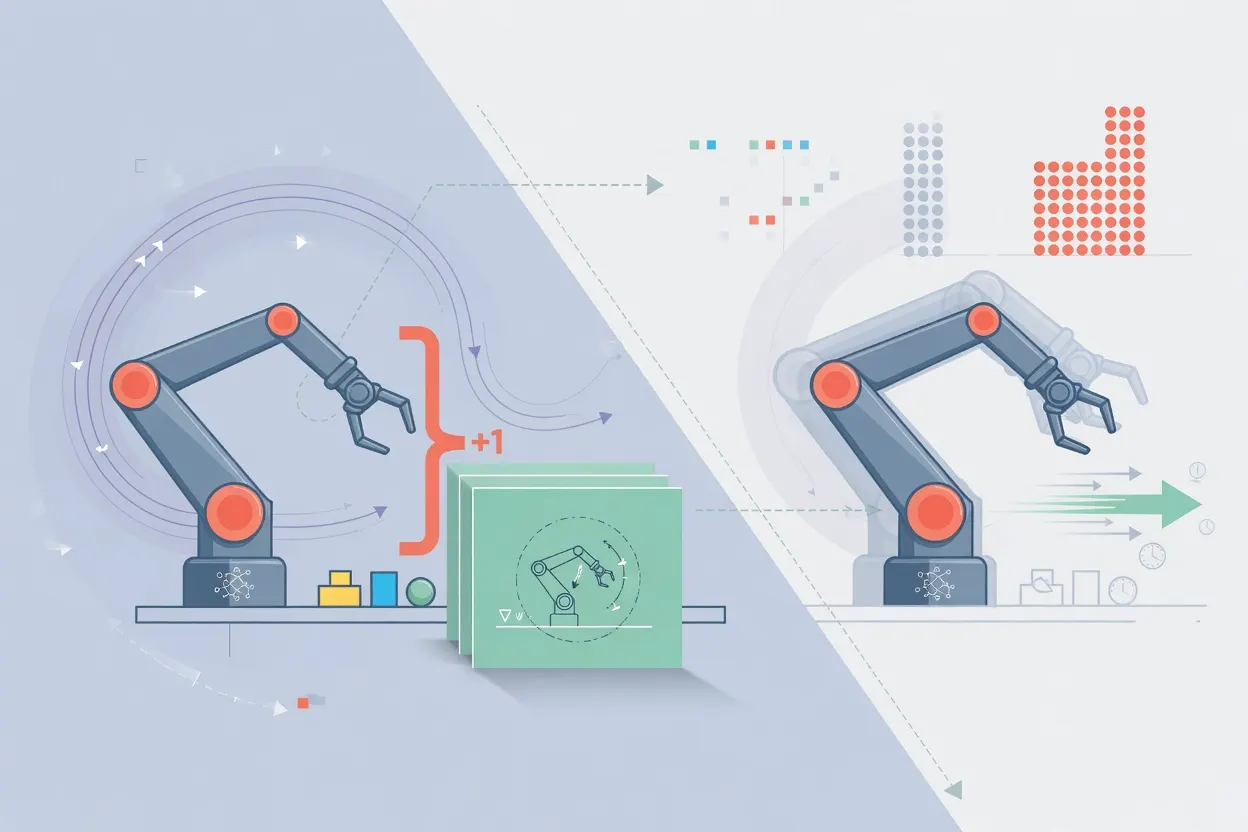
Vision-language-action (VLA) policies, the models that let robots turn a camera feed and a text instruction into physical movements, typically generate actions using flow matching: a process that refines random noise into an action plan over multiple steps. More steps usually means better actions, but also more compute and latency. A new method called Coda changes the formula. Instead of adding more refinement steps, it lets a frozen policy run a quick few-step pass, then hands the result to a small, separately trained Transformer that predicts a single correction based on the candidate action, the original noise, and cached observation data. On 50 RoboTwin Easy tasks, five-step Coda pushed success from 71.64% to 74.68% versus a matched five-step baseline, while cutting latency 30.2% relative to the standard ten-step version. A two-step variant hit 71.88% success at more than double the speed.
This matters because robotics has been stuck treating inference steps as a tax you pay for reliability: want a robot that doesn't drop the mug, add more compute. Coda suggests that tax is partly avoidable. Applying the same correction module to SmolVLA, an existing open-source policy, without retraining it, raised two-step success from 60.8% to 69.4%. That's the more interesting result. A technique that bolts onto other people's frozen models and improves them is a lot more useful than one that only works in its own bespoke pipeline.
The usual caveat applies: these are simulated benchmark tasks, not a warehouse floor. Whether a learned residual correction holds up against real sensor noise and real physics is the next question worth asking.