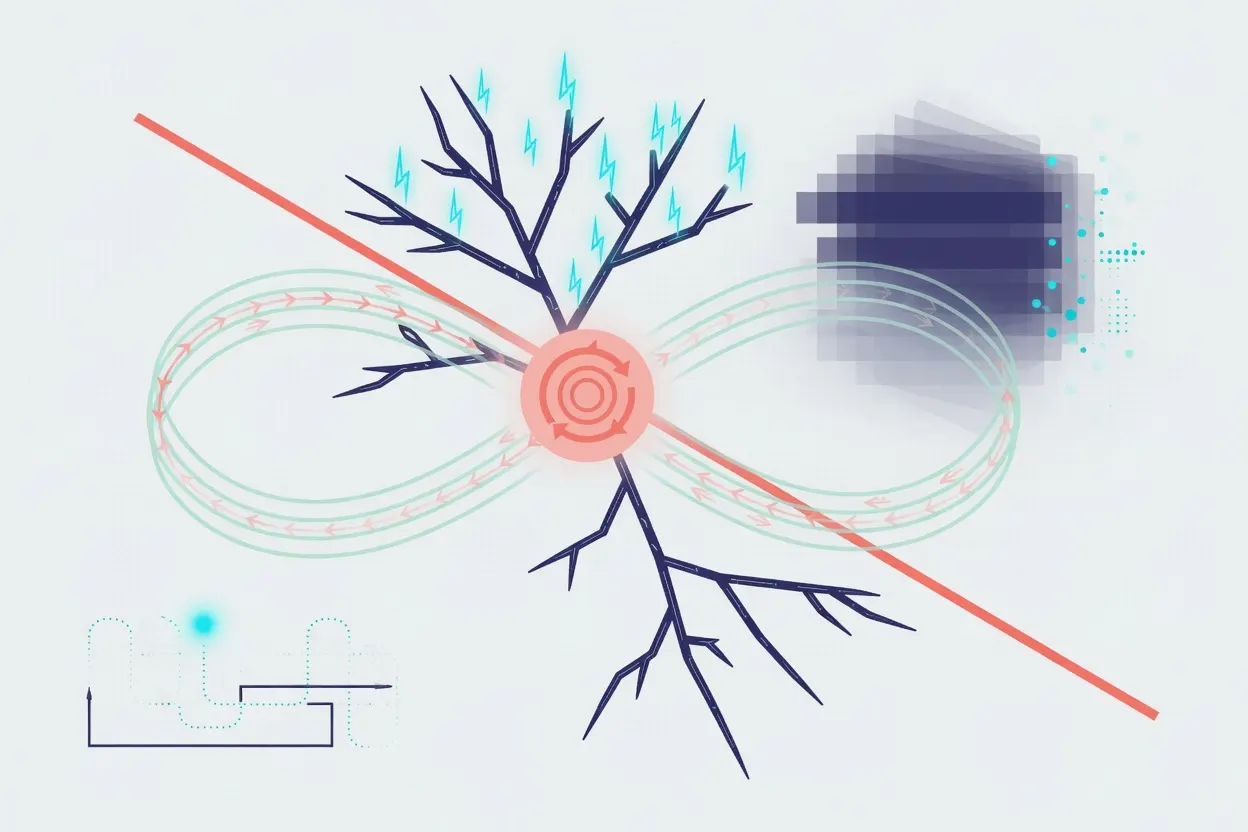
A small simulated brain learns to hold onto who it is, even after its short-term memory is cleared.
Researchers built a minimal agent on a spiking neural network substrate (using leaky integrate-and-fire neurons) and tested whether a signal they call "self-caused credit" could produce lasting behavioral change. The mechanism is an agency gate: a multiplicative switch that lets slow parameter updates accumulate only when the agent detects itself as the cause of an outcome. In 50 trials, a self-preserving learned choice survived full removal of the episodic memory buffer with a retained fraction of 0.96. Removing the slow credit channel or the agency gate alone collapsed that number to zero.
Catastrophic forgetting, where learning new tasks erases old ones, is one of the oldest unsolved problems in machine learning, and fixes almost always involve replay buffers or explicit task labels. This paper found that an agency-gated slow credit mechanism, with no replay and no task-boundary signal, retained eight sequentially-learned tasks at a post-unload accuracy of 0.88 and a forgetting rate of 0.13; every baseline method fell to near chance-level recall after the episodic buffer was removed.
The authors are precise about one thing: none of this implies consciousness. But self-preservation as a structural feature of a learning mechanism is an interesting place to hunt for solutions to AI reliability problems that have nothing to do with awareness.