Researchers have a new technique for squeezing capability from large AI models into smaller ones — and it sidesteps a trap that existing methods fall into.
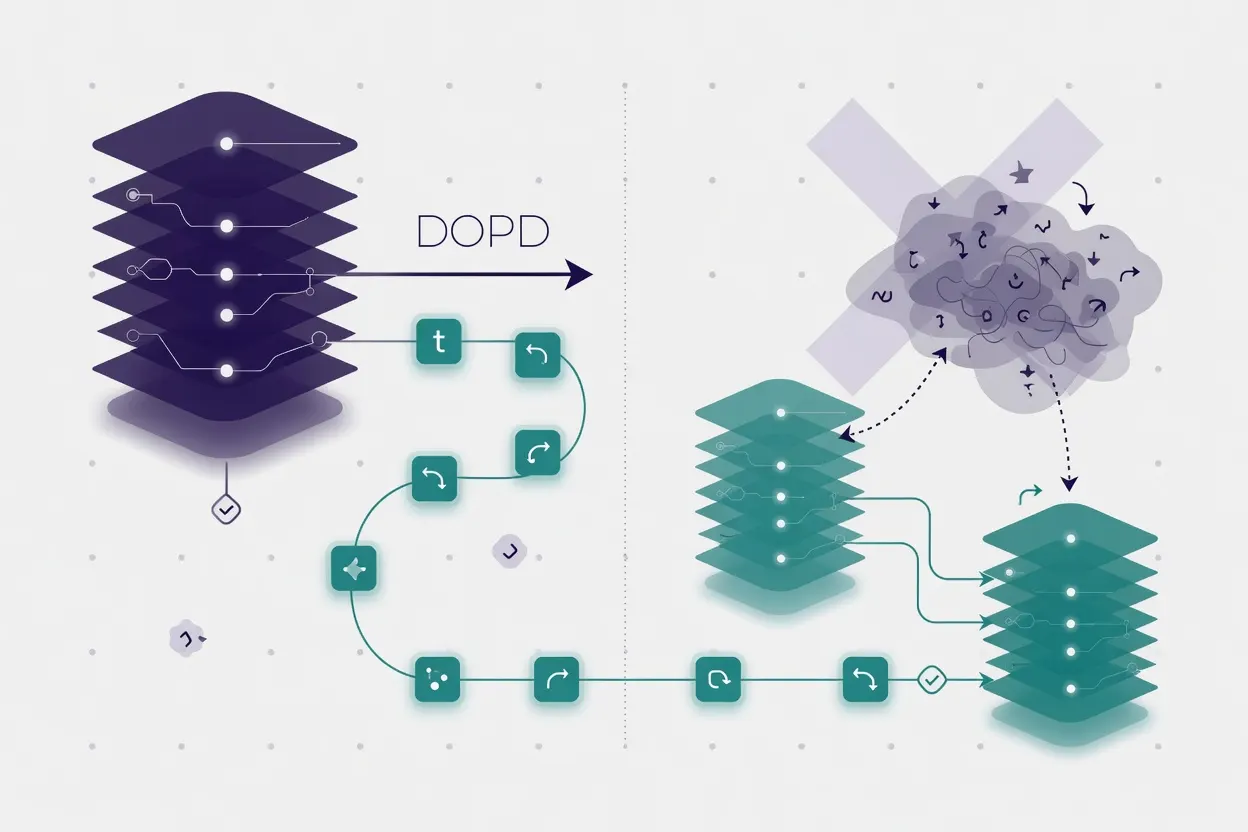
The paper introduces DOPD, short for Dual On-policy Distillation. Standard on-policy distillation trains a smaller "student" model by having it generate outputs and then correcting those outputs using a larger "teacher" model's signals. The problem: when either the teacher or student gets fed extra privileged information — context the other side doesn't have — the student can't tell whether it's learning a real skill or just mimicking an information advantage it will never possess at inference time. The researchers call this privilege illusion. DOPD addresses it by scoring each generated token on an advantage gap between teacher and student, then routing supervision accordingly — some tokens get strong teacher guidance, others get student-side reinforcement, and the mix shifts dynamically.
Distillation is how most production AI teams get smaller, cheaper models without training from scratch, so closing these failure modes has real cost implications. The privilege illusion problem also points at a broader issue in AI training: benchmarks and transfer methods can flatter a model that's leaning on cues unavailable at deploy time.
The authors tested DOPD on both language and vision-language models and report consistent gains over vanilla on-policy distillation. Whether those gains hold outside controlled research settings — where privileged information is more ambiguous and less neatly labeled — is the question every distillation paper eventually has to answer in production.