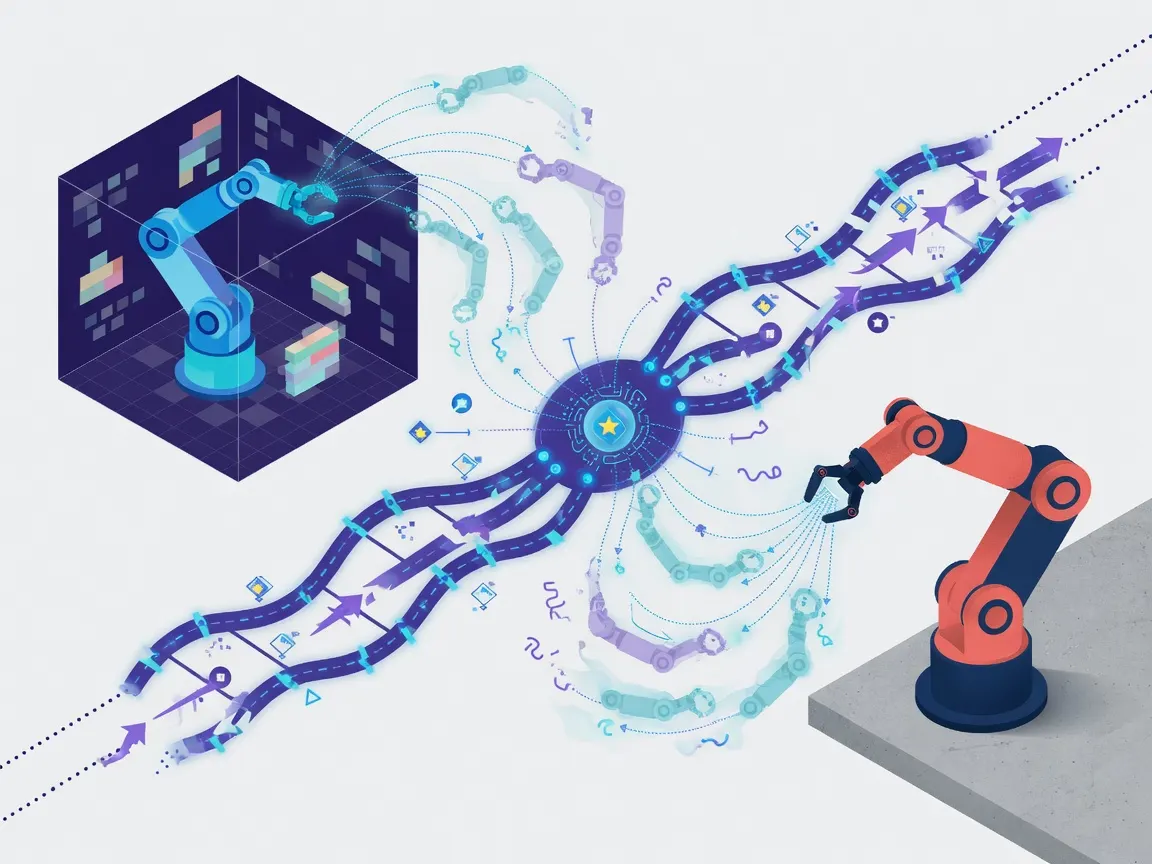
A new domain adaptation framework called AIDA lets vision-based reinforcement learning agents transfer from simulation to reality without requiring large pools of real-world data.
Sim-to-real transfer is a persistent headache for robotics and vision-based control: an agent trained in a simulator sees a different distribution of images once deployed in the real world, and performance collapses. Most domain adaptation approaches paper over this by assuming researchers have enough target-domain data to bridge the gap - an assumption that rarely holds outside the lab. AIDA, proposed in a new arXiv preprint, sidesteps that requirement by generating what the authors call "adaptive imagination" rollouts. A discriminator monitors those synthetic transitions and cuts them off the moment they drift into low-confidence territory, so only plausible, reliable imagined data gets used to augment the scarce real-world observations.
The practical upshot is that AIDA can adapt an agent without any additional interaction with the target environment - a meaningful constraint in robotics, where real-world trials are slow, expensive, or physically risky. A self-consistency loss that cycles from state to image observation and back penalizes drift in the learned representations, giving the model a richer training signal than the limited real data alone could provide.
Tested across five MuJoCo control tasks and two Gymnasium-Robotics environments, AIDA outperforms existing baselines when the target data budget is tight. The benchmark suite is well-regarded but still synthetic; how the approach holds up against the full messiness of physical hardware remains an open question.