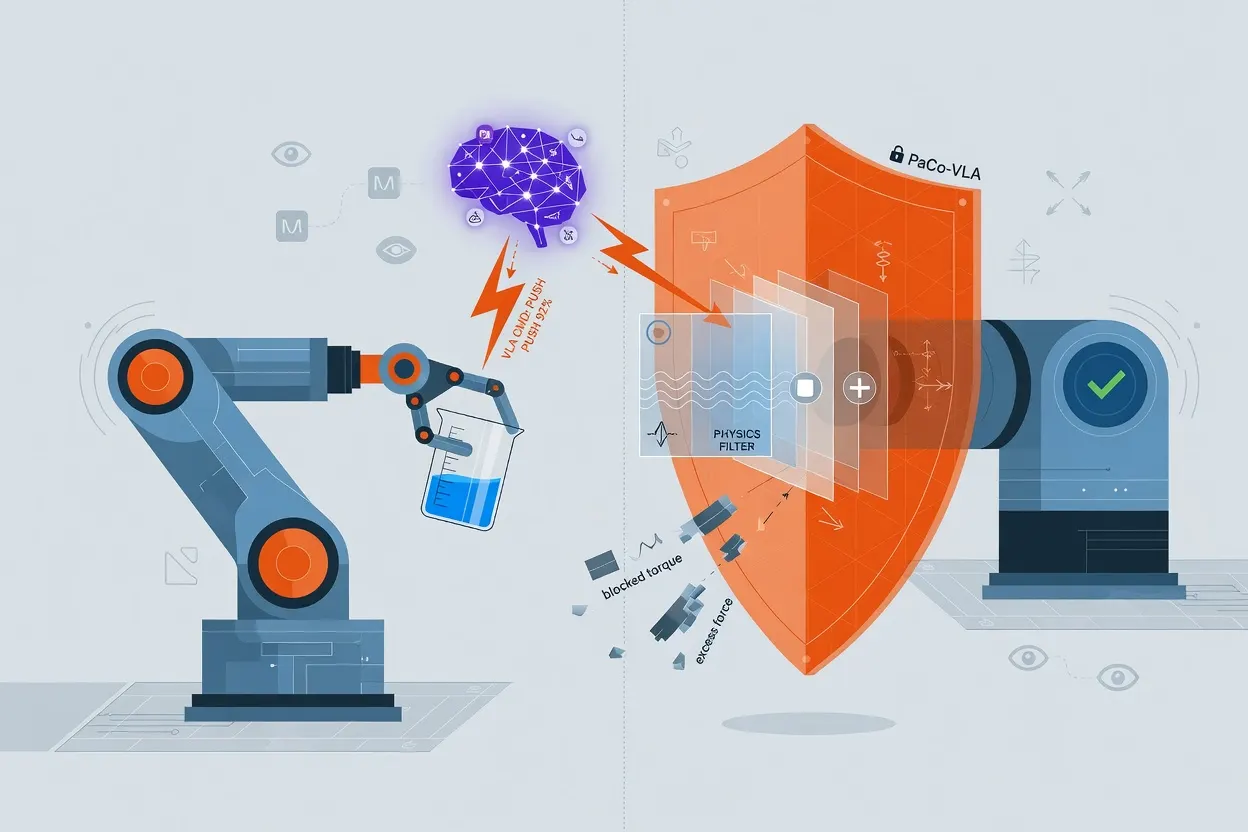
A new robotics framework keeps AI models from directly controlling delicate, contact-heavy tasks like plugging in a connector.
Researchers built PaCo-VLA, a system that sits between a vision-language-action model and a robot's motors. Instead of letting the AI output raw motor commands, the model proposes task-level compliance settings - how much force to allow, and what stage of the task it thinks it is in. A separate, high-frequency passivity shield checks those proposals against real-time contact physics before anything reaches the hardware, using energy-tank accounting to catch invalid or stale predictions. In simulated and real-world connector-insertion tests, the shielded system was more precise than an unshielded VLA baseline and recorded zero passivity violations, even when the team deliberately shifted the required compliance mid-task.
VLA models are good at understanding what a task is, translating natural language and vision into action, but they run at low update rates and were never designed to be trusted with millisecond-by-millisecond force control. This work is essentially an admission that letting a language model touch the motors directly is risky for anything involving real contact, and it offers a template, keep the AI as an advisor rather than a controller, for other contact-rich robotics work.
It's a narrower, more cautious approach than the let-the-foundation-model-drive-everything pitch that has shaped recent robotics demos, and probably a more honest one.