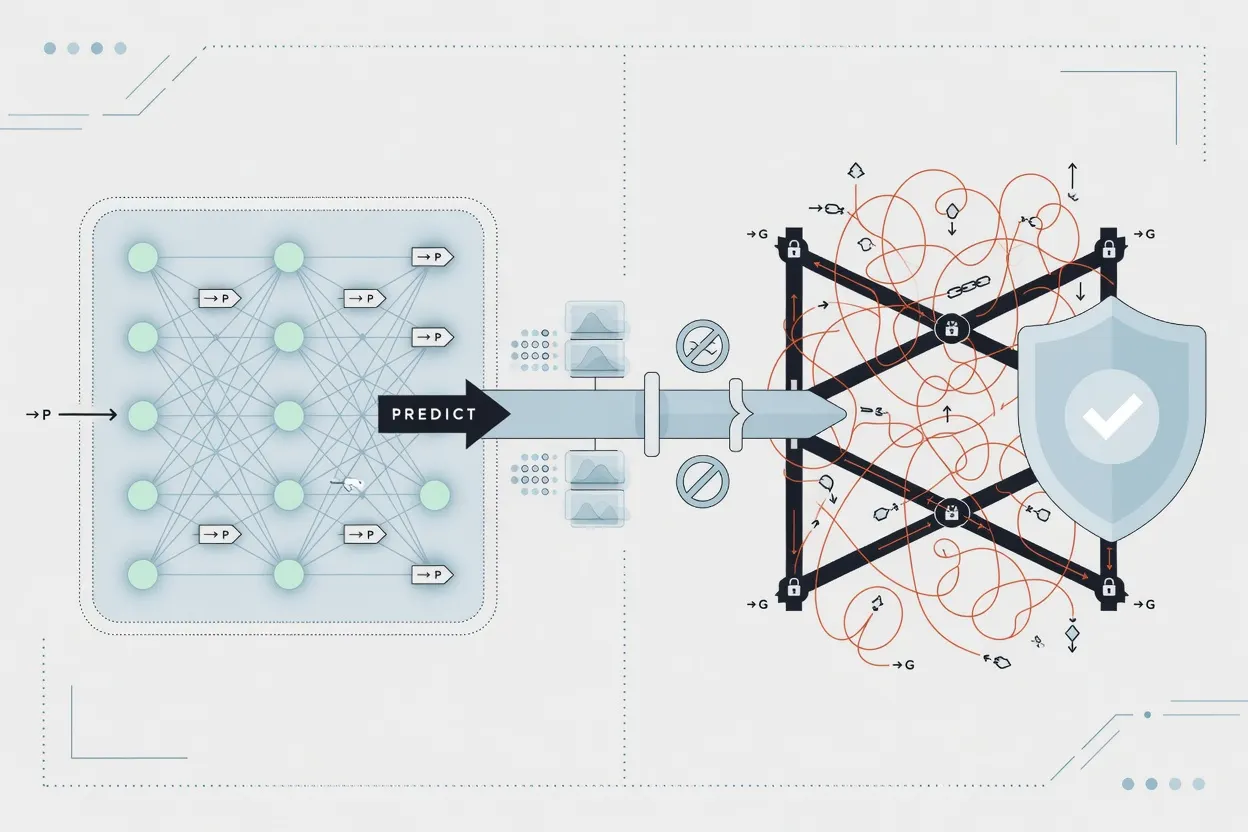
A new paper argues you can build a safer AI by training it to predict the world rather than act on it.
The research, posted to arXiv, introduces the Scientist AI Predictor — a system trained to approximate what statisticians call a Bayesian posterior: essentially, the best probability estimate over outcomes given a dataset. The key design choice is "epistemic contextualization," which means the training data is structured so the model treats expressed goals as facts to be explained, not drives to be adopted. Downstream effects of any prediction are never fed back as a reward signal, which is meant to keep the system from developing implicit agency — goal-directed behavior that no one explicitly programmed in. Any actual agency needed to get things done is handled by separate scaffolding with its own guardrails.
This matters because the standard way of training powerful AI — optimizing for outcomes — creates a subtle risk: a model may develop internal goals aligned with the training objective rather than with human intent. The paper offers a formal proof that, under stated assumptions about training dynamics, the probability of producing a Predictor that causes harm above a specified threshold is small, because coordinated deception across many queries would be both rare under the starting conditions and unrewarded during training. The authors argue that the same constraints that make the system accurate also make systematic deception costly.
The obvious caveat: the guarantees rest on assumptions about training dynamics that are argued, not empirically verified at scale. The alignment research community has seen formally elegant proposals before; the hard part is always whether the math survives contact with real training runs on large models.